

NovaStar MCTRL1600 LED Controller: Complete Guide 2026
2026-03-03T03:54:39+00:00March 3, 2026|Tags: FAQs NovaStar|
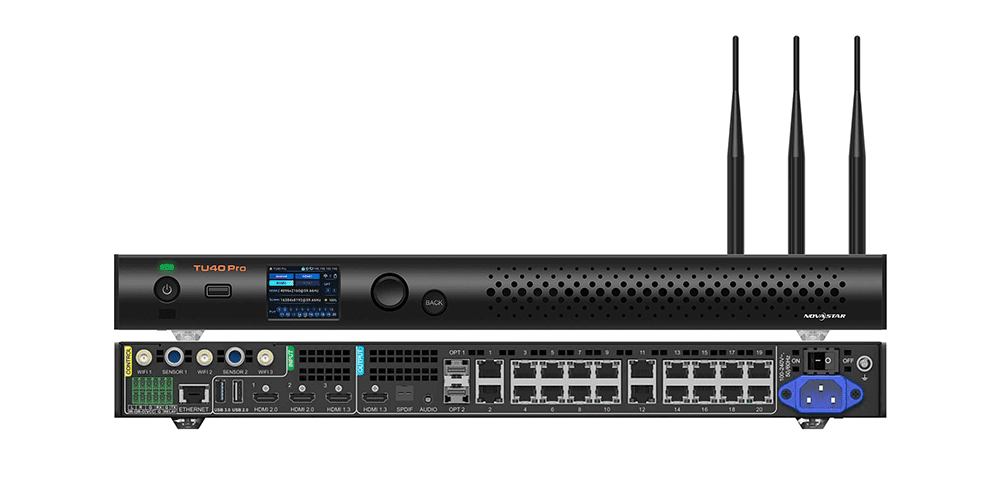
NovaStar TU40 Pro Specifications: Everything You Need to Know
2026-02-26T03:52:39+00:00February 26, 2026|Tags: FAQs NovaStar|
Colorlight X8m Ultra-4K LED Video Processor Review: Performance, Features & Advantages
2026-02-02T03:18:55+00:00February 13, 2026|Tags: FAQs Colorlight|
In the ever-evolving world of advanced LED display technology, the controller is no longer just a device for transmitting signals—it’s the backbone of an entire system. For large-scale projects requiring ultra-high resolution, seamless synchronization, and robust reliability, the NovaStar MCTRL1600 stands out as a top-tier solution. Designed specifically for professional-grade installations, this 4K LED display controller offers unparalleled performance, flexibility, and engineering adaptability.
Whether you’re managing live events, broadcast studios, or immersive commercial environments, the NovaStar MCTRL1600 ensures that your LED displays deliver exceptional image quality and operational stability. Let’s dive into what makes this controller a game-changer in modern LED display systems.
Table of Content
1.What Is the NovaStar MCTRL1600?
The NovaStar MCTRL1600 is a high-end, standalone 4K LED display controller designed for large-scale, high-brightness, and mission-critical LED display systems. It integrates video processing, signal distribution, color management, and redundancy into a single professional control platform.
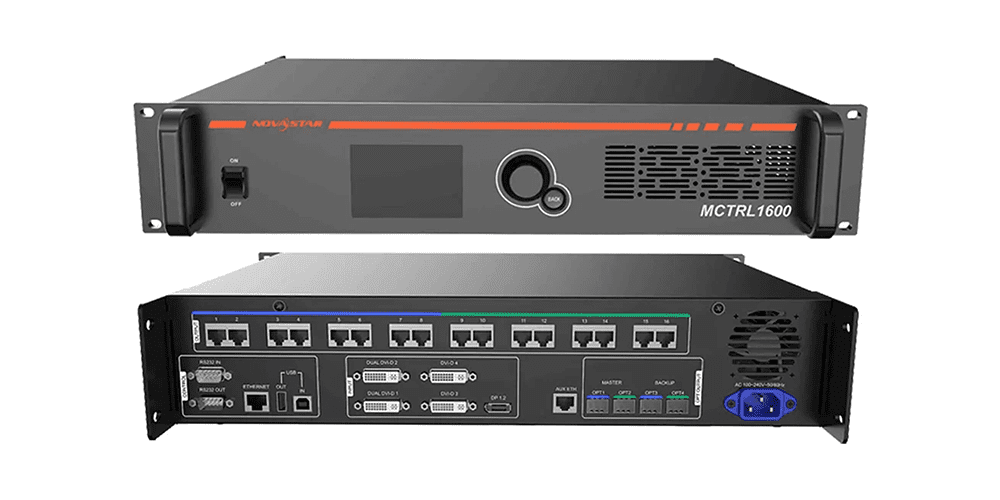
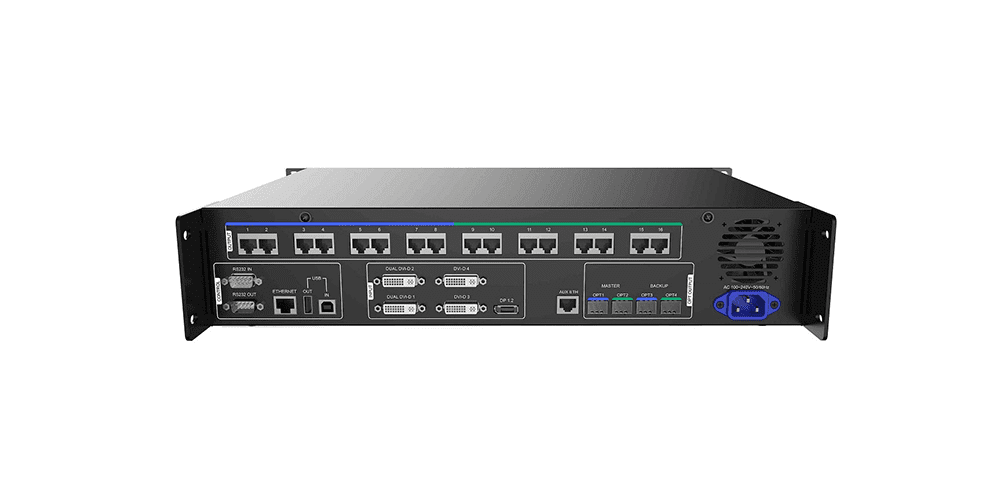
Supporting up to 4096×2160@60Hz, the NovaStar MCTRL1600 features DP 1.2 and DVI inputs, 16 Gigabit Ethernet outputs, and 4×10G fiber outputs for stable long-distance transmission. With HDR10 / HLG, up to 12-bit color depth, and advanced calibration capabilities, it delivers exceptional color accuracy, uniformity, and system reliability for demanding engineering and broadcast applications.
2.Core Technical Specifications Overview
As a flagship 4K LED controller, the NovaStar MCTRL1600 is built to meet the demands of ultra-high-definition and complex display applications. Below is a concise overview of its key specifications covering inputs, outputs, display performance, and system architecture.
| Specification Category | Detailed Description |
| Input Interfaces | Supports 1×DisplayPort 1.2 and 4×DVI simultaneously, offering flexible video source configurations. The DP 1.2 interface provides high bandwidth, ideal for single-port 4K 60Hz input, while multiple DVI ports are useful for multi-window splicing systems. |
| Output Interfaces | Equipped with 16×Gigabit Ethernet ports (industrial-grade Neutrik EtherCON connectors) and 4×10G optical fiber outputs, this setup ensures reliable transmission over long distances and supports large-scale screen splicing. Optical ports offer link redundancy and synchronized transmission, suitable for outdoor, XR, or stage display installations. |
| Maximum Resolution | Supports up to 4096×2160@60Hz per input. Custom output resolutions are also supported, with a maximum horizontal or vertical expansion of up to 7680 pixels, enabling ultra-wide or irregular-shaped screen configurations. |
| Color Depth Support | Compatible with 8-bit / 10-bit / 12-bit output. When combined with HDR, it delivers wider color gamuts and smoother gradation transitions, creating a more dynamic and layered image quality. |
| HDR Compatibility | Supports HDR10-Optima and HLG (Hybrid Log-Gamma)—two widely used HDR formats. These modes enhance realism and dynamic range, making the controller ideal for XR production, live broadcast, and high-fidelity display content. |
| Gamma Adjustment | Provides independent RGB gamma curve tuning, allowing for targeted grayscale optimization across each color channel. This ensures detailed shadow reproduction and is especially beneficial in stage lighting scenarios with frequent brightness shifts. |
| 3D Display Support | Natively supports Frame Packing 3D output, and can be paired with an external EMT200 module to deliver immersive stereoscopic visuals. Suitable for high-end showrooms, interactive exhibitions, and immersive experience centers. |
| Chassis Design | Uses a standard 2U rack-mount structure with a full-metal enclosure. The front panel features status indicators and an OLED display for real-time monitoring and quick diagnostics—streamlining both installation and maintenance. |
| Operating Environment | Designed for wide-temperature operation (-20°C to 70°C), ensuring long-term reliability in extreme conditions such as outdoor installations, live concerts, sports arenas, and cityscape displays. |
These specifications highlight that the NovaStar MCTRL1600 is more than a standard 4K controller—it’s a high-performance, all-in-one solution for advanced, high-bandwidth LED display applications, offering excellent scalability, stability, and adaptability in complex deployments.
3.In-Depth Analysis of Key Functional Highlights
3.1 Ultra-High Capacity & Flexible Resolution
The NovaStar MCTRL1600 supports true 4K input (4096×2160@60Hz) and easily handles ultra-wide or ultra-tall LED screens. Custom resolution mapping ensures pixel-perfect display without stretching or distortion, making it ideal for creative layouts and non-standard LED installations.
3.2 Optical Hot Backup for Stable Signal Transmission
With four 10G fiber ports and automatic failover, the NovaStar MCTRL1600 switches instantly to a backup link if a signal fails—ensuring uninterrupted visuals for live events, broadcasts, and XR productions.
3.3 HDR & High Color Depth for Better Image Quality
Supporting HDR10-Optima, HLG, and up to 12-bit color depth, the NovaStar MCTRL1600 delivers brighter highlights, richer colors, and smoother gradients—perfect for premium advertising, 3D billboards, and exhibitions.
3.4 Native 3D Support
Built-in hardware 3D support enables true stereoscopic visuals with low latency and high brightness, ideal for immersive museums, showrooms, and themed attractions.
3.5 Dual Working Modes for Flexible Deployment
It can operate as a powerful standalone sending card or as a fiber controller for long-distance, large-scale projects—adapting easily to simple or complex system architectures.
4.Recommended LED Screen Applications for NovaStar MCTRL1600
4.1 Large-Scale Stage LED Screens
Ideal for concert LED walls and live event backdrops, delivering HDR visuals with 10/12-bit color depth. Multi-controller synchronization and fiber hot backup ensure stable, flicker-free LED screen performance.
4.2 Sports Stadium LED Displays (Main & Ribbon Screens)
Supports ultra-high resolution LED scoreboards and perimeter screens with long-distance 10G fiber transmission, guaranteeing reliable and interference-free image output across large venues.
4.3 8K & Ultra-Wide LED Video Walls
Enables pixel-level precise splicing for large-format LED walls, panoramic displays, immersive showrooms, and architectural LED screen installations.
4.4 XR Virtual Production LED Walls
With Genlock sync and ultra-low latency, it ensures frame-accurate LED wall output for XR stages, virtual studios, and in-camera visual effects workflows.
4.5 Glasses-Free 3D LED Screens
Native Frame Packing 3D support provides bright, accurate stereoscopic visuals for landmark LED displays, shopping malls, and immersive advertising screens.
4.6 Command & Control Room LED Displays
Designed for 24/7 LED screen operation, supporting multi-signal inputs, color calibration, and long-term stable performance for monitoring centers, traffic control rooms, and security applications.
5. NovaStar MCTRL1600 vs. Other Models–Simplified Comparison
NovaStar offers controllers for every project level, from entry-level to flagship. Here’s a concise comparison of three key models:
| Model | Max Resolution | Interface Configuration | HDR Support | 3D Support | Optical Output |
| MCTRL600 | 1920×1200@60Hz | DVI×1, HDMI×1, 1G Ethernet Ports×4 | ❌ | ❌ | ❌ |
| MCTRL4K | 4096×2160@60Hz | DP×1, DVI×2, 10G Optical Ports×2 | ✅ | ✅ | ✅ |
| NovaStar MCTRL1600 | 4096×2160@60Hz | DP×1, DVI×4, 10G Optical Ports×4 (w/ backup) | ✅ | ✅ | ✅ (with hot backup support) |
Summary
- MCTRL600:Simple, cost-effective setups
- MCTRL4K: Standard 4K, HDR, basic 3D
- NovaStar MCTRL1600: Advanced control, redundancy, and high-demand projects.
6.Deployment Tips for NovaStar MCTRL1600
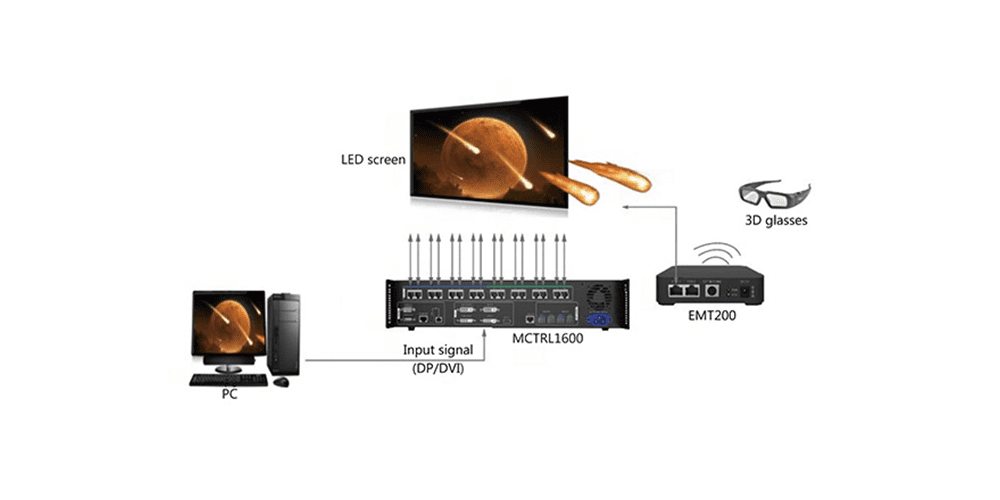
Deploying the NovaStar MCTRL1600 requires careful planning of controllers, signal links, and supporting hardware for stable, synchronized, and redundant operation.
6.1 Use CVT10 Pro Fiber Converters
Pair the NovaStar MCTRL1600’s 4×10G optical outputs with CVT10 Pro converters for:
- 10Gbps bandwidth for uncompressed 4K@60Hz
- Bi-directional optical-to-Ethernet conversion
- Hot backup failover to prevent blackouts
- Rugged, industrial-grade protection
6.2 Configure via NovaLCT Software
Load RCFG files to match receiving cards, import module parameters, perform grayscale & color calibration, and set screen zoning for multi-output control.
6.3 Enable Redundancy
Power: Dual-input UPS for uninterrupted supply
Fiber: Assign separate primary and backup fiber paths
Software: Activate Primary/Backup detection in NovaLCT
7.Conclusion
The NovaStar MCTRL1600 is more than a high-definition sending card—it’s a flagship LED controller that combines 4K@60Hz processing, HDR imaging, synchronized 3D, fiber hot backup, and dual power support. It excels in large-scale deployments, from concert stages and glasses-free 3D displays to XR virtual production, transportation hubs, and command centers.
Its strengths—image consistency, system stability, and flexible configuration—make it a trusted choice for integrators and end users alike. By mastering its interfaces, fiber redundancy, and NovaLCT settings, integrators can improve efficiency, reduce rework, and ensure scalable, secure, and reliable LED control for any high-demand project.
 NovaStar TU40 Pro Specifications: Everything You Need to Know