
2026-10-27T13:29:34+00:00October 27, 2026|
2026-10-27T13:23:03+00:00October 27, 2026|
2026-10-27T13:12:56+00:00October 27, 2026|
A curved LED wall radius cannot be specified by saying “make it curved.” Give the supplier the intended inside or outside radius, available floor width, screen height, viewing side, and whether the wall is concave, convex, or a closed ring. The supplier then needs to confirm that the chosen cabinets, optional angle hardware, support design, and service clearances can produce that geometry. A photo of a curved stage is not a mechanical specification.
This guide is for an AV rental company planning a reusable event backdrop before ordering cabinets. It focuses on the curved LED wall radius and the drawings needed for a practical quote. It does not assume a published minimum radius for every product; even cabinets advertised for curved installation need a model-specific angle range and approved rigging plan.
Define the curved LED wall radius from the audience side
Begin with a plan view of the stage or exhibition stand. Mark the center of the curve, intended viewing side, endpoints, and permitted footprint. For a concave backdrop, the display faces inward toward the audience or performance area; for a convex display, it faces outward. State whether the radius is measured to the front LED surface, the cabinet centerline, or a support line. Those reference lines are different, especially when the cabinet and rigging have meaningful depth.
Provide both the desired chord width—the straight distance between endpoints—and the depth or sweep of the curve. A wall can occupy the same endpoint width while using a very different arc length and number of cabinets. If the design is a full ring, state its clear inner opening, outer clearance, and access route. Include the screen height and whether the top follows a flat line; a curved plan does not imply a curved elevation.
Ask the designer to label dimensions in meters and feet, for example 6 m (19.7 ft), and provide the CAD file or measured venue drawing where available. A stage rendering may suggest the shape, but it seldom establishes cabinet joint angles or tolerances. The curved LED wall radius should appear on a dimensioned plan that the screen, staging, and rigging teams can all review.
An arc lock is a capability, not an unlimited bend
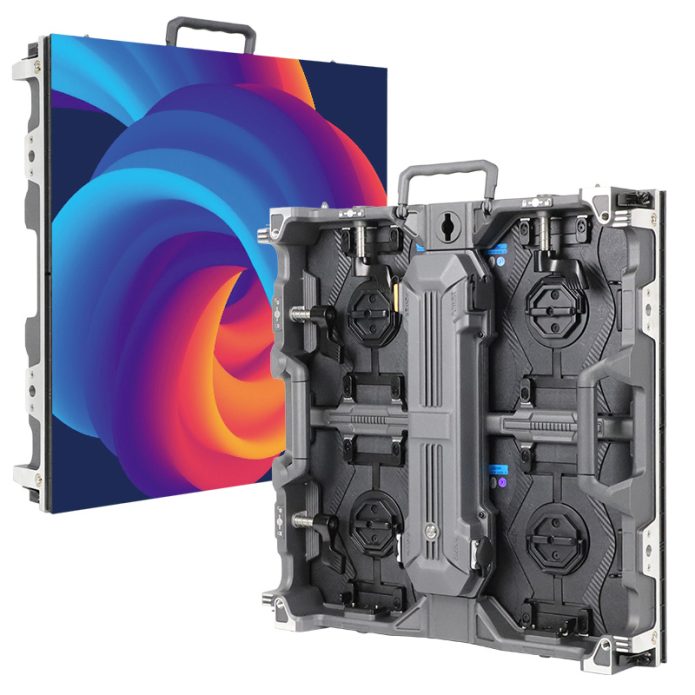
Rigid rental cabinets form a curve by meeting at approved joint angles. They do not bend continuously. The site’s EA500H9 product page describes an optional curved lock and curved or ring installations, but it does not provide a universal minimum radius for every cabinet arrangement. The EA1000C6 product page also describes arc installation. Treat each as a candidate to check against the actual hardware option, pitch, cabinet orientation, and approved angle range.
Ask for the supported inward and outward lock settings in degrees, the permitted number of cabinets in a row, and any edge or transition pieces. A 500 mm (19.7 in) cabinet, for instance, is a geometric module; its width alone does not tell you the achievable radius. The relationship between cabinet width and joint angle changes with where the radius is measured. Get the supplier’s cabinet-by-cabinet drawing rather than applying a generic “radius calculator” to an unspecified lock.
Confirm whether the chosen lock is standard or optional, and whether it is installed on every vertical joint. Verify the hardware is included in the quote and that crews can repeat the chosen setting at each event. A wall built from several pitch or cabinet variants needs a separate compatibility check. Do not combine systems solely because their panels look similar or share nominal dimensions.

Request a cabinet layout before pricing the curve
A quotation should show the proposed cabinet count and orientation, not just total square meters. Ask for a top-view cabinet layout showing every joint angle, overall arc length, chord, depth, and reference radius. Where the shape meets a flat screen, specify the transition and check the image seam. A ring needs a closure detail and a plan for accessing its interior or exterior after assembly.
The comparison table below turns the curved LED wall radius into concrete approval items. It is a drawing request, not a claim that one cabinet model fits every listed shape.
| Drawing item | Decision it supports | Evidence to request |
|---|---|---|
| Concave or convex face; radius reference | Prevents opposing teams from measuring different surfaces. | Dimensioned plan with center and viewing side marked. |
| Cabinet row and joint settings | Tests the curve against actual lock positions. | Cabinet map, lock option, approved angle range. |
| Footprint and clearances | Checks fit with stage, audience, egress, and service. | Chord, curve depth, support footprint, access zones. |
| Content and control canvas | Shows what the audience will see along the arc. | Native pixel map, source format, test content plan. |
For a repeat rental inventory, also ask whether a flat configuration uses the same cabinets and which extra locks, cases, frames, or spares are needed to switch between shapes. That matters more to an event company than a one-off drawing alone. The rental LED wall guide addresses the wider booking and system checklist; this article narrows the decision to geometry and curve-specific hardware.
Approve support, cables, and service around the arc
Curve geometry changes support loads and access routes. A freestanding wall, ground-supported ring, and suspended arc need different structural solutions. Obtain a project-specific design from qualified staging or structural personnel using the actual cabinet mass, support system, venue limits, wind conditions if outdoors, and applicable local requirements. Do not infer safe suspension from a product photo or a curved-lock feature.
Check how power and signal cables cross angled joints and how a failed module, receiving unit, or power supply can be serviced. The rear of a tight concave wall may be hard to reach, while a closed ring may trap equipment inside. Confirm the service side for the chosen cabinet, tool clearance, cable bend allowance, ventilation, and a safe access path. The curved LED wall radius can be mechanically feasible yet operationally poor if service cannot be performed.
Ask the installer to inspect the first assembled row for consistent joints and visible seams before the full wall is built. If a curve is near the limit of the hardware, small alignment errors can accumulate around the arc. Agree on an acceptance check for surface alignment and image continuity under real viewing conditions. The supplier should explain what can be adjusted on site and what requires a revised layout.
Plan the image for the physical curve
The native pixel map follows the cabinet arrangement; the audience sees that map on a curved surface. A standard flat 16:9 video may appear different from side positions, especially near a deep concave edge. Ask the content team for a visual mockup from the intended audience zones and a test of text size, logos, and key subjects. Keep critical information away from places where viewing angles or stage equipment hide it.
A curved LED wall radius does not increase native pixel resolution. Confirm the width and height in pixels for the chosen pitch and cabinet count, then confirm processor output and mapping. The site’s resolution guide explains how cabinet dimensions and pitch determine pixel count. For a ring or mixed cabinet layout, request a specific signal-routing map instead of assuming a simple rectangular canvas.
Rehearse cameras and live content when those are part of the event. Camera position, shutter settings, and screen settings can affect the recorded image, while the curve changes viewing angle across the shot. These are project checks, not evidence that any curved cabinet automatically solves camera artifacts.
Frequently asked questions
Can a flat-only rental cabinet make a curved wall?
Do not force a cabinet or lock beyond its approved geometry. Use a manufacturer-supported arc-lock option, an approved angle cabinet, or a flexible-module system chosen for the actual shape. Confirm the current hardware and support method in writing.
Is inside radius the same as outside radius?
No. Cabinet and support depth separate the display face, cabinet centerline, and rear line. State which surface a drawing measures, especially for a ring where the clear inner opening determines access.
Can we quote a curved screen from overall width alone?
Not reliably. The same endpoint width can be built with different curve depths and arc lengths. Provide the intended radius or both chord and depth, height, viewing side, and venue constraints so the cabinet layout can be checked.
Send a dimensioned curved-wall request
Share the installation country, indoor or outdoor setting, stage or exhibition footprint, screen height, closest viewing distance, concave or convex direction, radius reference, and repeat-use requirements. Request a cabinet map, optional lock schedule, support and service assumptions, native pixel map, and itemized quote. Send the project plan to EagerLED so the curved LED wall radius can be reviewed against a specific system instead of a rendering alone.