

2026-10-09T02:41:38+00:00October 9, 2026|Tags: 3D Billboard, LED Display Knowledge, Naked-Eye 3D|
2026-09-28T02:49:48+00:00September 29, 2026|Tags: FAQs NovaStar|
2026-09-22T02:47:54+00:00September 25, 2026|Tags: LED Display Knowledge|
A 3D billboard can make a product appear to extend beyond a building façade, yet the image remains on the LED surface. The effect is usually created through anamorphic content: imagery designed for the relationship between a particular screen and a particular viewing position. Understanding that relationship is the starting point for specifying a convincing naked-eye 3D installation.
For LED display buyers, distributors, AV integrators, and project contractors, the challenge goes beyond selecting a bright screen. A proposal must connect cabinet geometry, audience sightlines, video production, control systems, installation access, and long-term maintenance. A weakness in any one of those areas can compromise the finished result.
This guide explains how the technology works and how to evaluate a 3D billboard project from initial survey through commissioning. It also separates the cost of owning an installation from the cost of producing content or booking advertising space, helping procurement teams compare equivalent scopes.
1. What Is a Naked-Eye 3D Billboard?
A naked-eye 3D billboard is a display installation that presents an apparent sense of depth without requiring viewers to wear glasses. For the anamorphic format discussed here, that impression comes from the displayed imagery and its intended viewpoint.
The term describes an experience rather than one universal hardware architecture. Anamorphic LED advertising, optical autostereoscopic displays, and physical three-dimensional signs are different systems, even though marketing materials sometimes group them together.
In an anamorphic installation, ordinary direct-view LED technology displays perspective-adjusted content. The screen does not need to deliver a separate image to each eye. Ocean Outdoor identifies its own DeepScreen format as an application of anamorphosis that creates apparent depth from a specific vantage point.
For procurement purposes, define the requested result before discussing products. Is the client buying an outdoor corner display, an indoor product showcase, or airtime on an existing media façade? Calling all three a “3D billboard solution” leaves too much unspecified.
A useful project description names the location, screen surfaces, audience area, content responsibility, and operating conditions.
2. How Do 3D LED Billboards Create the Illusion of Depth?
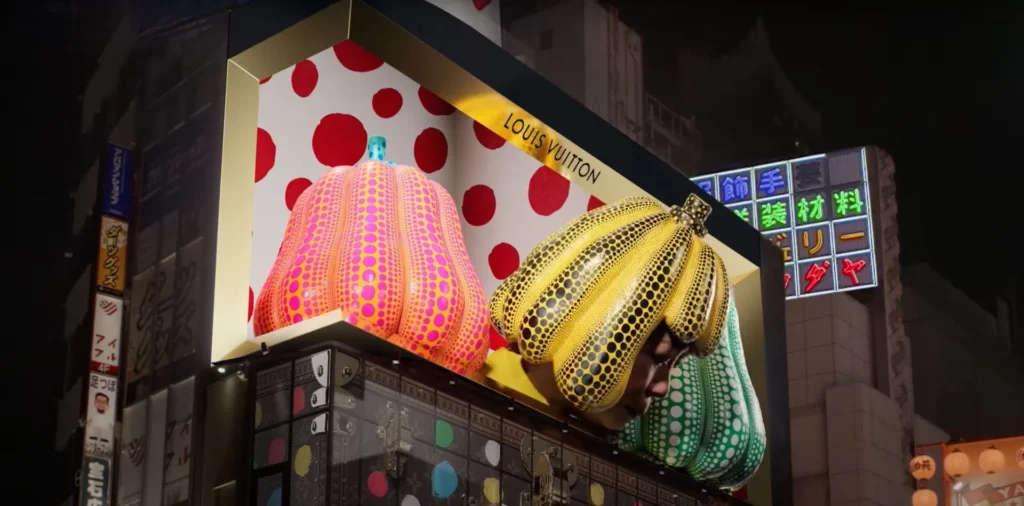
An anamorphic 3D billboard uses a deliberately arranged perspective to make a displayed scene resemble a volume of space.
Consider a proposed animation of a watch rotating inside a display case. The illustrated case establishes a floor, rear wall, and opening. Lighting and overlap help distinguish these surfaces. When the watch crosses the illustrated opening, the visual sequence suggests movement toward the viewer.
The production team builds this scene around the actual installation geometry. From the intended observation point, the image should line up with the viewer’s expectations of a three-dimensional object. Elsewhere, the same content may look stretched.
The illustrated opening is especially important: an object can appear to cross a border drawn inside the image, although no image pixels exist outside the physical LED surface.
For a 3D billboard, apparent depth is therefore a content outcome supported by the display. Higher brightness or finer pixel pitch can improve image presentation, but neither generates the perspective effect by itself.
3. Why Viewing Angle and Screen Shape Matter
The preferred viewing position should be established before the screen dimensions are finalized. Designing the installation first and discovering the audience position later can force expensive creative compromises.
For a 3D billboard site survey, mark where people actually pause, the height of the screen above them, and the direction from which they approach. A large pedestrian count is less useful if most people see the installation from a severe side angle.
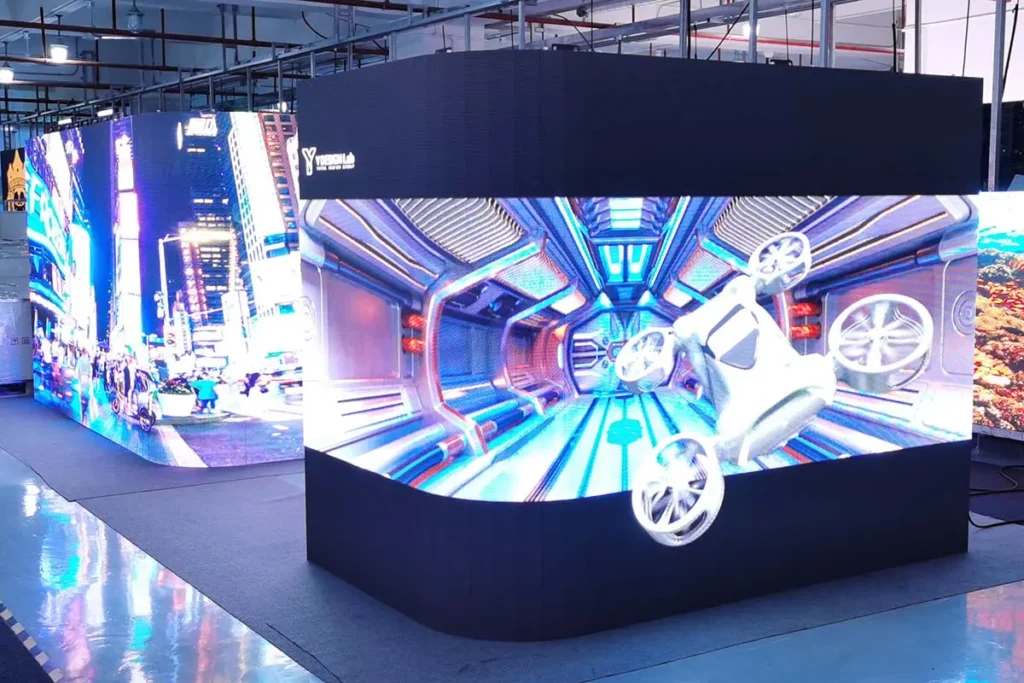
Corner screens give designers two connected surfaces to work with. Curved transitions can support a continuous-looking scene, but they do not remove viewpoint dependence. A flat installation can also work where the main audience approaches from a predictable direction.
Use this survey checklist before approving a 3D billboard layout:
On smaller screens, swipe the table horizontally to see all columns.
| Site question | Evidence to collect | Decision it informs |
|---|---|---|
| Where will viewers pause? | Photographs and marked observation points | Primary creative viewpoint |
| What interrupts the sightline? | Trees, structures, signs, and temporary obstructions | Screen position and visible image area |
| How close can viewers get? | Nearest and typical viewing distances | Pixel pitch and content detail |
| How does daylight reach the façade? | Orientation and observations at relevant times | Brightness evaluation and shading |
| How will technicians reach it? | Access routes and working clearances | Cabinet service direction |
| What surfaces are proposed? | Dimensioned elevation and corner drawings | Content mapping and structural coordination |
Request previews from both the preferred position and surrounding pedestrian routes. These reveal how the design behaves beyond the best camera angle.
4. How Is 3D Billboard Content Created?
Treat content production as a coordinated engineering and creative package. The studio needs reliable installation data before it can produce a dependable final render.
Start with an approved screen drawing, exact pixel canvas, surface arrangement, and audience viewpoint. Give the studio usable product models or artwork, brand requirements, and the intended message.
For a new 3D billboard, organize approvals around four deliverables.
First, approve a geometric test. A simple shape moving across the proposed screen can reveal mapping problems before the team invests in detailed animation. Ask to see this test within a model of the actual façade.
Second, approve the creative sequence. Agree on what viewers should recognize, when the product appears, and how the brand remains readable. Separate the visual spectacle from the essential communication so neither gets lost.
Third, lock the technical delivery specification. Record pixel dimensions, frame rate, codec, playback duration, loop behavior, and audio requirements, if any. Confirm these with the media operator or integrator instead of assuming a standard video export will be accepted.
Finally, approve the installed result. Check the animation on the real display, including the corner transition, color consistency, and any clipping caused by processing or scaling.
Ocean Outdoor’s DOOH creative guidelines emphasize checking each location’s production specifications. A studio example from Flipbook’s Domino’s campaign likewise describes building content around the operator’s screen templates.
Keep a revision log for the 3D billboard throughout production. A late change to screen height, corner radius, or output mapping should trigger a review of the content rather than an assumption that the existing render still fits.
5. 3D vs. Standard LED Billboards: Benefits and Limitations
The same LED installation can carry conventional advertising and anamorphic content. The commercial difference lies in how much production effort and location specificity the campaign requires.
On smaller screens, swipe the table horizontally to see all columns.
| Evaluation point | Conventional LED campaign | Anamorphic 3D campaign |
|---|---|---|
| Creative objective | Communicate a message clearly | Use apparent depth to support the message |
| Content preparation | Layout and video adapted to the screen | Geometry-aware animation and mapping |
| Viewing position | Less dependent on one perspective | Strongest within a planned viewing area |
| Reuse across sites | Often adaptable through layout changes | May need new perspective work and rendering |
| Approval process | Artwork and playback checks | Additional geometry and on-site checks |
| Campaign flexibility | Suitable for frequent message changes | Changes may involve more production work |
A 3D billboard gives creative teams a way to demonstrate scale, reveal a product, or stage an unexpected interaction with the building. That opportunity is valuable when it serves a recognizable message.
The limitations deserve equal attention. Detailed text can compete with the animation. Recognizable objects may look distorted outside the preferred viewpoint. A visually impressive sequence can still fail to communicate the advertiser’s name.
Before choosing the format, write down the campaign’s success criteria. For a media owner, these might include qualified advertiser inquiries and booked inventory. For a brand, they might include measured recall or attributable visits. A 3D billboard should be assessed against those objectives, not simply the popularity of its launch video.
6. Where Do 3D Billboards Work Best? Applications and Examples
The strongest candidate locations combine a useful sightline with an audience that has time to understand the scene. Use the following applications as planning categories rather than guarantees of performance.
Retail destinations: A product reveal can connect the display to a nearby store or shopping area. Check whether the preferred viewing zone falls within the customer’s actual approach route.
Entertainment venues: Character animation and scheduled event content can support launches or arrivals. Coordinate the sequence with the time available before visitors move indoors.
Commercial plazas: A 3D billboard can form part of a longer-term media program. Plan the content refresh process as carefully as the opening campaign.
Exhibitions and showrooms: Controlled visitor routes can make perspective planning easier. Close viewing also makes image detail and cabinet transitions more noticeable.
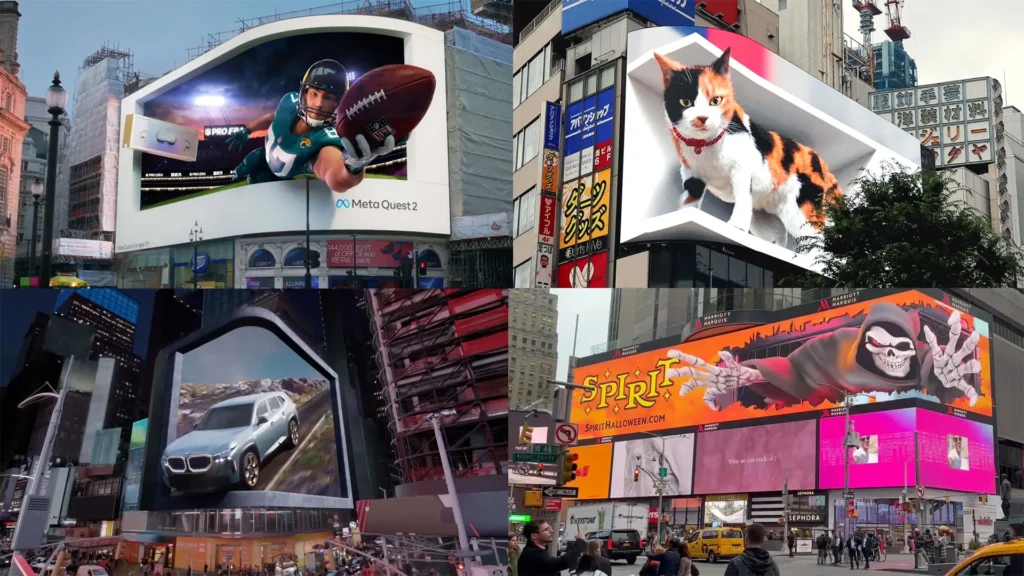
Verified installations show different uses of the medium. d’strict’s WAVE, first presented in Seoul in 2020, uses a giant moving wave as public media art. The creator’s account identifies anamorphic illusion as the technique behind the work.
In West Hollywood, The Now’s corner-cube display combines multiple LED faces, including an underside, for advertising and art. Daktronics’ project announcement discusses the need to align those surfaces.
These examples demonstrate creative possibilities. They do not establish a universal return on investment for another 3D billboard in a different market.
7. Which LED Screen Specifications Matter Most?
A 3D billboard specification should describe measurable performance under the planned operating conditions. “High definition” and “high refresh” are insufficient acceptance criteria on their own.
01. Pixel pitch, physical size, and native resolution
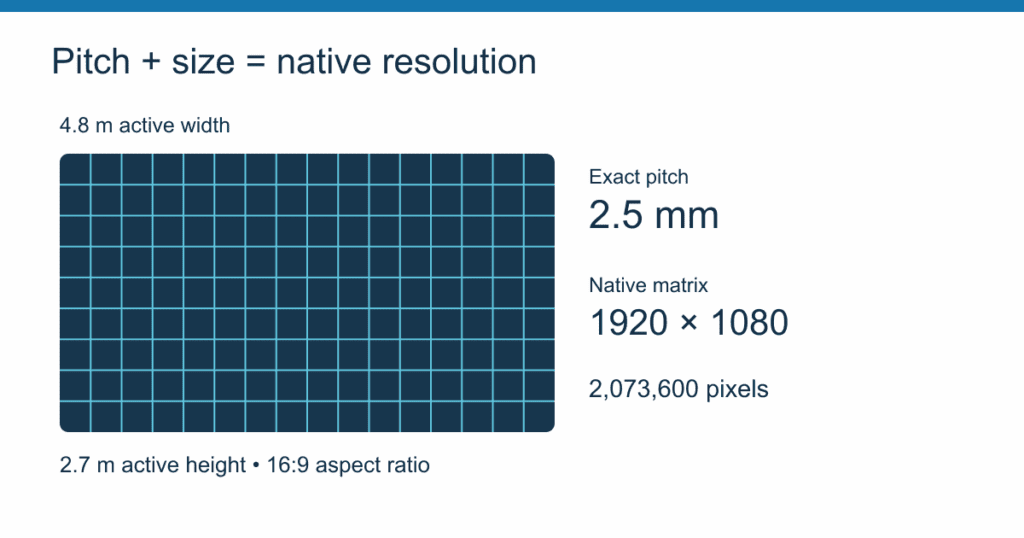
Pixel pitch is the center-to-center spacing between adjacent pixels. A smaller pitch provides more pixels within a given area, but the appropriate choice depends on viewing distance and required image detail. Daktronics’ viewing-distance guidance explains this relationship.
For a nominal flat surface:
Horizontal pixel count ≈ screen width in millimeters ÷ pixel pitch in millimeters
Use that calculation for early planning, then obtain the actual cabinet-based resolution. Do not specify a 3D billboard only as “4K”; record the complete native pixel dimensions and surface layout.
02. Brightness, contrast, and low-gray performance
Evaluate brightness against the site’s ambient light and operating schedule. Ask for the proposed daytime setting, dimming method, and nighttime test conditions.
Shadow detail also matters. Brompton describes how LED processing limitations can introduce banding, color shifts, and unevenness in dark imagery in its technical discussion of low-brightness performance.
Include dark gradients and slow tonal transitions in the demonstration, alongside bright promotional footage. A convincing daytime demonstration does not establish how the display will behave after dimming.
03. Refresh rate and camera performance
Content frame rate and LED refresh rate describe different processes. The first concerns successive video images; the second concerns the display’s light-output timing.
For a 3D billboard intended to be filmed, test actual phones and production cameras. A headline refresh-rate value cannot guarantee artifact-free footage across every shutter setting. Brompton’s ShutterSync documentation explains the importance of matching LED timing and camera exposure.
04. Processing, synchronization, and maintenance
Check input compatibility as well as output capacity. NovaStar’s VX1000 specifications, for example, list input limits, maximum output dimensions, and total pixel loading separately. These limits must be evaluated together.
Use a requirement matrix to turn the 3D billboard quotation into a testable proposal:
On smaller screens, swipe the table horizontally to see all columns.
| Requirement | Ask the supplier to document | Acceptance method |
|---|---|---|
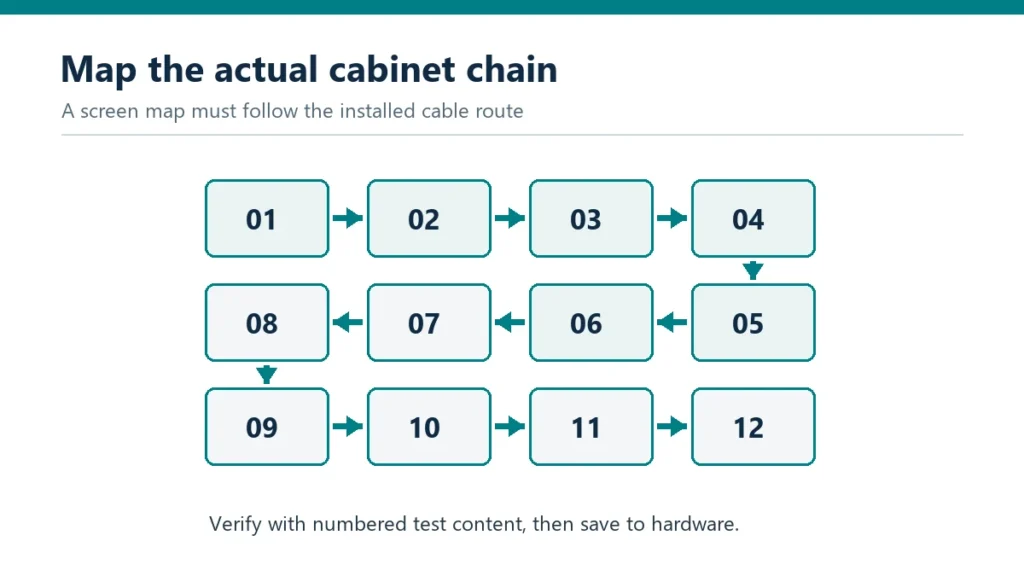
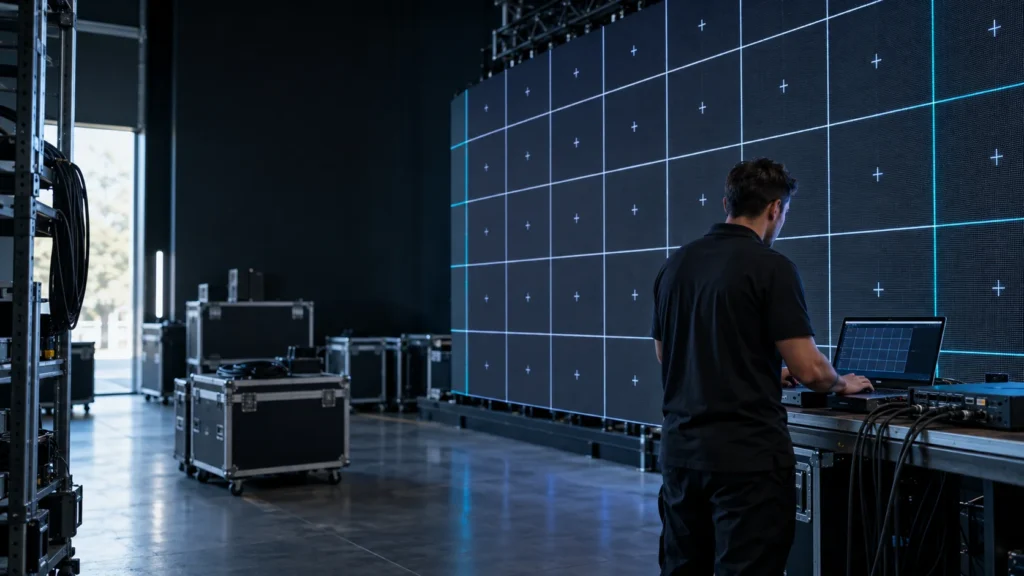
| Native canvas | Exact pixels and cabinet map | Display a numbered mapping grid |
| Surface continuity | Joint construction and adjustment method | Inspect lines crossing each transition |
| Uniformity | Calibration method and retained settings | Compare solid colors and grayscale patterns |
| Playback | Supported format and agreed frame rate | Run the final file without unplanned scaling |
| Synchronization | Signal architecture across display faces | Observe motion crossing output boundaries |
| Camera behavior | Tested cameras and exposure settings | Record representative footage |
| Service access | Replaceable parts and access direction | Demonstrate a maintenance procedure |
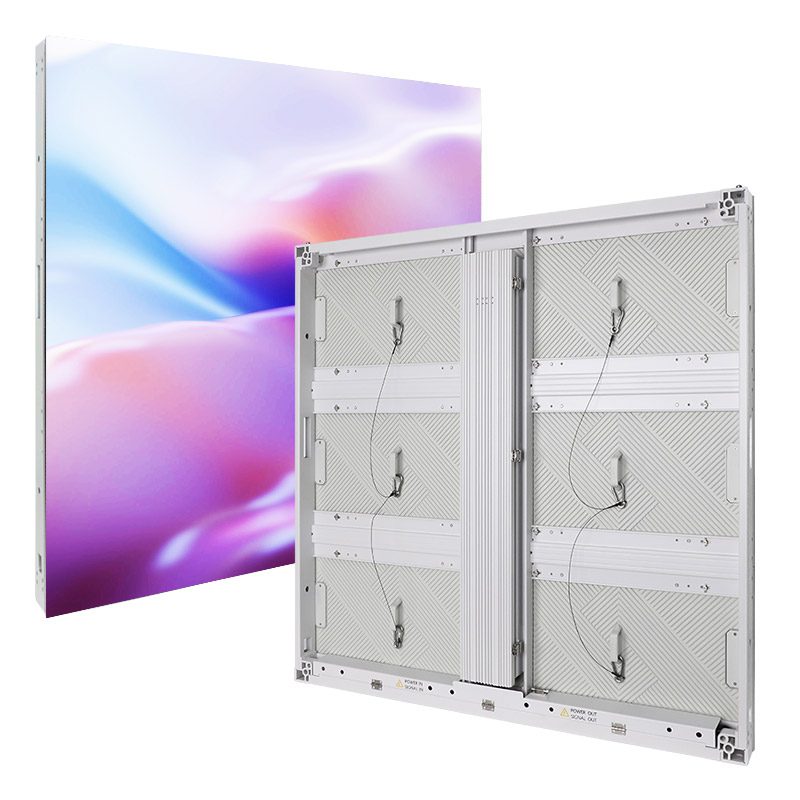
For hardware research, EagerLED’s EA960F3 product page describes front and rear service and an optional customized curved corner cabinet. Confirm the proposed configuration in the project quotation; a product-family page does not settle every installation detail.
8. How Much Does a 3D Billboard Cost to Build and Run?
A meaningful 3D billboard price requires a defined scope. Separate three purchasing situations: buying the installed display, commissioning animation, and renting airtime on an existing screen.
A square-meter equipment price does not represent all three. It may also exclude the support structure, electrical work, control equipment, transport, and commissioning.
Ask each bidder to complete the same cost schedule:
On smaller screens, swipe the table horizontally to see all columns.
| Cost category | Items to identify separately | Comparison question |
|---|---|---|
| LED equipment | Cabinets, modules, corner components, and spares | Is the configuration identical across bids? |
| Control system | Processing, playback, distribution, and backup options | What equipment is included end to end? |
| Installation | Support work, access equipment, cabling, and labor | Which site works remain with the contractor? |
| Content | Concept, modeling, animation, adaptation, and testing | How many versions and revisions are included? |
| Logistics | Packing, freight, insurance, and delivery scope | At what point does buyer responsibility begin? |
| Operation | Power, service, cleaning, and content updates | What assumptions support the annual estimate? |
| Media placement | Schedule, airtime, and operator charges | Is this needed in addition to ownership costs? |
For a 3D billboard ownership budget, request maximum electrical demand and expected average operating consumption as separate figures. Ask the supplier to explain the content and brightness assumptions behind the average estimate.
A transparent operating calculation is:
Energy cost = average system power (kW) × operating hours × electricity tariff per kWh
Calculate display and auxiliary equipment consumption where relevant. Use local tariffs and the intended schedule rather than treating a manufacturer’s maximum power figure as continuous real-world consumption.
Content costs should identify what happens after delivery. Does the agreement include seasonal variants, new product models, source files, or re-rendering for another location? Those decisions can materially change the long-term cost of a 3D billboard campaign.
For commercial evaluation, build conservative and optimistic revenue scenarios. Keep guaranteed bookings separate from possible premium rates or earned media exposure. Avoid assuming that visual novelty alone establishes a payback period.
9. How to Choose a 3D Billboard Supplier and Content Partner
Choose partners who can explain how responsibilities connect. The display manufacturer, local contractor, creative studio, and media operator may be separate companies, so the interfaces between them need explicit ownership.
Provide the same request-for-quotation package to each 3D billboard supplier:
On smaller screens, swipe the table horizontally to see all columns.
| RFQ input | What to provide | Why it matters |
|---|---|---|
| Site context | Location photographs and façade drawings | Makes the proposal site-specific |
| Display layout | Dimensions, surfaces, and proposed corner geometry | Establishes the equipment and content canvas |
| Audience | Main viewpoint and viewing distances | Supports pitch and perspective decisions |
| Operating conditions | Schedule, exposure, and available services | Defines the environment to be evaluated |
| Creative scope | Message, assets, duration, and update plans | Separates hardware from production work |
| Delivery responsibility | Named parties for each work package | Reduces gaps between quotations |
| Acceptance plan | Tests, evidence, and approval roles | Defines what completion means |
Request a technical review with the creative team before releasing final fabrication drawings. This is the point to resolve mismatches between the desired illusion and the proposed physical screen.
For a 3D billboard distributor or integrator, the handover package is commercially important. Request approved drawings, cabinet and cable maps, configuration backups, spare-part identification, operating instructions, and a recorded commissioning checklist. Establish who retains access to these materials.
Ask for relevant project evidence rather than relying only on edited showreels. Useful evidence includes uncut playback, nearby viewpoints, maintenance photographs, and an explanation of the supplier’s actual role.
Define escalation routes for a launch-day problem. If the image tears at a corner or a logo appears distorted, the client should not have to decide which company owns the fault.
When discussing a project with EagerLED, submit the site and audience information alongside the requested dimensions. This gives the hardware discussion a practical foundation and makes the resulting 3D billboard proposal easier to coordinate with the local installation and content teams.
10. FAQ
01. Can an existing flat LED screen become a 3D billboard?
Potentially. Start with a perspective test using the existing screen’s dimensions and audience position. Then evaluate image quality, playback, and available content space. Replacing the hardware should follow an identified limitation rather than the assumption that every anamorphic project requires a corner screen.
02. Does a 3D billboard need stereoscopic mode on the controller?
A conventional anamorphic video does not inherently require left-eye/right-eye switching. Confirm what a controller’s “3D” feature actually supports; that label may refer to a different display method. Select processing around the required canvas, signal format, synchronization, and playback workflow.
03. Can existing product models reduce animation costs?
They can reduce asset-creation work if their quality, materials, and usage permissions suit the project. Ask the studio to inspect them first. A model prepared for engineering or online retail may still need substantial adjustment for animation, close views, and large-screen rendering.
04. Who should own the animation source files?
Make this a contract decision. Specify whether delivery includes editable scenes, textures, project dependencies, and only licensed assets that can legally be transferred. A finished video file may be sufficient for playback but insufficient for future modifications by another studio.
05. What happens if the screen dimensions change after approval?
Notify the creative team before proceeding. A dimensional change can affect the modeled surfaces, pixel canvas, and intended perspective. Ask for an impact assessment covering content changes, rendering, and another verification pass. Include this process in the change-control agreement.
06. Can a 3D billboard run without a permanent internet connection?
A system designed for local file playback can continue without continuous connectivity. Remote scheduling, monitoring, live data, and updates may still depend on a network connection. Require an offline demonstration and specify what should happen when connectivity returns.
07. What spare parts should the buyer request?
Ask for a project-specific list covering relevant modules, power supplies, receiving hardware, cables, and any specialized corner components. Agree on quantities, identification, compatibility, and replenishment lead times. Also request the configuration and calibration information needed when replacing components.
08. How can buyers verify whether a viral billboard video is real?
Look for confirmation from the venue, media operator, installer, or credited production studio. Request unedited footage from several positions. Some promotional clips depict computer-generated outdoor scenes; they do not prove that the advertised effect was displayed on an installed screen.
09. Can interactive content work on a naked-eye 3D billboard?
Yes, when the playback and production system supports it. Ocean Outdoor describes real-time interactive applications within its DeepScreen offering. Specify the input method, response behavior, fallback scene, and operating responsibilities. Interactivity does not automatically remove the installation’s viewing constraints.
11. Conclusion
A 3D billboard succeeds when the audience position, physical display, creative content, and playback system are developed together. Naked-eye 3D is an optical presentation technique, so hardware quality must support a correctly designed scene.
For buyers and contractors, the next step is a documented site brief and a coordinated proposal. Compare the full installed scope, request representative tests, and agree on maintenance and creative responsibilities before committing.
To discuss an EagerLED 3D billboard project, prepare the screen dimensions, site photographs, preferred viewing area, service access, and operating schedule. Those details turn an initial visual idea into a proposal that can be evaluated, priced, and delivered.

 NovaStar NovaLCT V5.9.2: Download, Installation & LED Screen Setup Guide