
2026-10-09T02:41:38+00:00October 9, 2026|Tags: 3D Billboard, LED Display Knowledge, Naked-Eye 3D|
2026-09-28T02:49:48+00:00September 29, 2026|Tags: FAQs NovaStar|
2026-09-22T02:47:54+00:00September 25, 2026|Tags: LED Display Knowledge|
How do 3D billboards work? They play perspective-designed animation on an LED screen so that objects appear to sit inside a deep space or extend beyond its frame. The depth is an optical illusion, usually strongest from a planned viewing position. Viewers need no glasses, and the object does not physically leave the display.
For advertisers, a successful 3D billboard starts with a clear message, a suitable audience viewpoint, and content made for the actual screen. A curved corner can help the composition, but buying an impressive display does not automatically create an effective campaign.
This guide explains 3D billboard advertising through practical examples, production decisions, cost categories, and measurement methods. It is written for brands and agencies planning outdoor campaigns. For a deeper hardware introduction, read our naked-eye 3D billboard guide.
Table of Contents
- 1. What Is a 3D Billboard?
- 2. How Do 3D Billboards Work?
- 3. Benefits of 3D Advertising for Brands and Businesses
- 4. Billboard Advertising Samples and Real-World Examples
- 5. Cost of 3D Billboard Advertising and ROI
- 6. Future of 3D Displays in Outdoor Advertising
- 7. How Businesses Can Use 3D Billboards
- 8. Why Choose EagerLED as Your 3D Billboard Manufacturer
- 9. 3D Billboard FAQs
- 10. Conclusion
- Get Quote Free
1. What Is a 3D Billboard?
A 3D billboard is a form of digital out-of-home advertising that uses visual depth cues to make a two-dimensional LED image appear three-dimensional. This article focuses on anamorphic, or forced-perspective, displays. The phrase can also describe physical advertising sculptures or mechanical signs, which work differently.
Conventional anamorphic content does not send a separate image to each eye. Instead, perspective, shadows, scale, and overlapping objects suggest depth. This explains why a phone recording can capture the effect and why the illusion changes as a pedestrian moves away from the intended viewpoint.
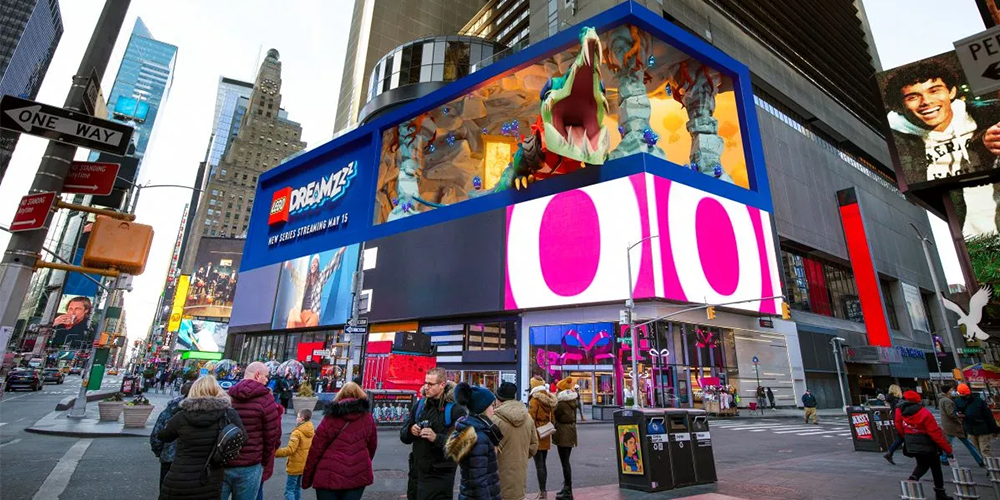
01. Technology Behind a 3D Billboard
The LED surface provides light and color; the animation provides the apparent depth. A virtual window or box establishes a reference plane. When a product passes in front of that simulated boundary, the viewer interprets it as protruding into the street.
- Corner or curved screens: Two visible faces can make the virtual space easier to establish. The creative team must account for the corner geometry.
- Flat screens: These can also show forced-perspective content. Success depends on framing and viewpoint, rather than a mandatory curved cabinet.
- Viewing zone: The useful audience area is narrower than the screen’s advertised LED viewing angle. Seeing a picture clearly and seeing convincing depth are different requirements.
2. How Do 3D Billboards Work?
A 3D billboard production connects four stages: survey the location, model the screen and audience viewpoint, render the animation, and test playback on the installed display. Each stage must use the same geometry. A late change to the screen’s proportions can require creative revisions.
01. LED Panels and Pixel Density
Pixel pitch is the distance between neighboring LED pixel centers. A smaller pitch gives more pixels within the same area, but audience distance and content detail determine whether the extra resolution is useful. There is no universal rule that every 3D billboard must be 4K.
For example, a hypothetical 10-meter-wide P5 surface has about 2,000 pixels across: 10,000 millimeters divided by 5 millimeters. Final dimensions follow cabinet increments. Request the native pixel map before commissioning animation; stretching a finished video to a different canvas can distort the illusion.
02. Creative Design and Forced Perspective
The artist builds a virtual scene around the measured display. A virtual camera represents the intended viewer’s eye position. Objects, lighting, and a simulated frame are composed from that camera, then mapped onto the physical LED surface.
For a 3D billboard, the apparent edge is especially important. A convincing shadow or overlap helps the product cross that edge visually. Keep the main action readable without sound, because street viewers may hear traffic rather than a soundtrack. Test a rough animation before paying for detailed textures and final rendering.
03. Content Integration and Playback
Deliver files to the media operator’s specifications for resolution, duration, frame rate, codec, and file size. Confirm whether the screen expects one combined canvas or separate synchronized outputs. Avoid unplanned cropping, scaling, or independent playback across faces.
Refresh rate and video frame rate describe different things. A high LED refresh specification alone does not guarantee clean phone footage. Film the proposed content using representative devices, including bright scenes, dark gradients, and fast motion. Check for bands, flicker, tearing, and visible corner seams.
04. User Impact and Viewing Limitations
A 3D billboard may look convincing from the main pedestrian area but stretched from a side street. Review both positions. A strong design retains a readable product and brand name even when the depth effect weakens.
Outdoor visibility also changes with daylight and surrounding signs. Plan brightness control with the operator and test the animation at the times it will run. Avoid judging the entire campaign from one carefully framed nighttime recording.
3. Benefits of 3D Advertising for Brands and Businesses
3D billboard advertising can support product launches and brand storytelling when visual scale serves the message. Its value should be judged against the campaign objective and a realistic alternative, such as conventional digital outdoor creative at the same location.
01. Attention with a Clear Message
Unexpected motion and apparent depth can attract attention. However, attention is useful only when viewers understand the advertiser and offer. Show the product early, limit competing messages, and keep the brand identifiable when someone joins halfway through the loop.
02. Social Sharing Potential
A 3D billboard can become material for social video, but organic distribution is not guaranteed. Budget for an approved launch recording and distinguish paid distribution from audience posts. Include enough street context to demonstrate that the footage shows a real installation.
03. Brand and Product Storytelling
Use the depth effect to explain a relevant benefit: a shoe’s cushioning, a device’s camera, or a package opening. An unrelated spectacle may entertain people without improving product understanding. Test whether viewers remember the brand as well as the animation.
04. Earned Media and Commercial Value
Evaluate a 3D billboard using separate measures for delivery, attention, response, and commercial results. Do not add street audience estimates and online video views together as though they represented unique people.
For a campaign report, record the measurement source, date range, geographic coverage, and comparison method. Describe earned-media value as a modeled estimate when applicable; it is not the same as booked revenue or incremental profit.
4. Billboard Advertising Samples and Real-World Examples
Useful 3D billboard examples show how the visual idea relates to the site and message. The following operator and brand sources document real installations. They provide creative references, not a promise that another campaign will achieve the same reach.
01. Iconic Campaigns in Asia
Cross Shinjuku Vision, Tokyo: The operator dates the arrival of the Shinjuku East Exit Cat to July 2021. Its official Cross Shinjuku website provides a reliable reference for the location. The creative lesson is how a recognizable character and an apparent enclosed space establish scale.
Samsung, Seoul: Samsung’s Tiger in the City campaign announcement connects the tiger to low-light smartphone photography. The 2022 campaign included Seoul and four other cities. Here, the animal supported a product story instead of functioning only as a visual surprise.
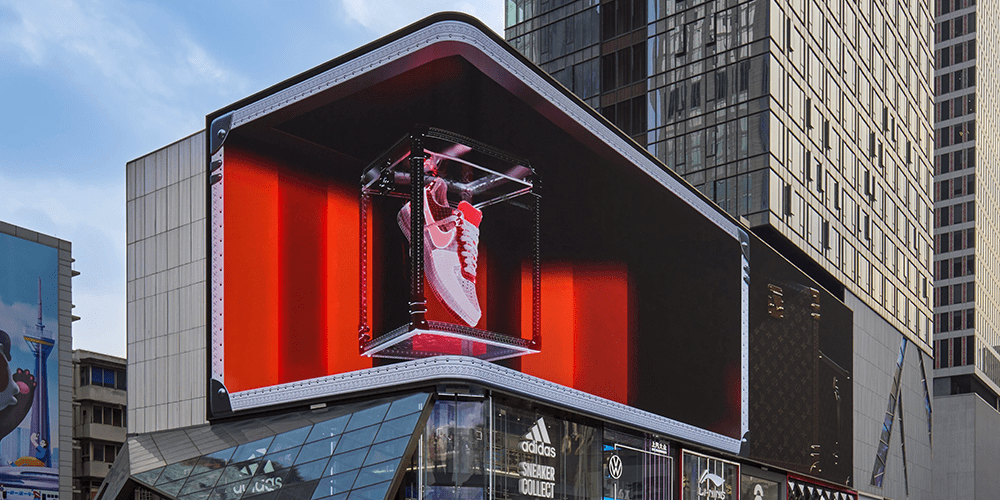
02. European Advertising Examples
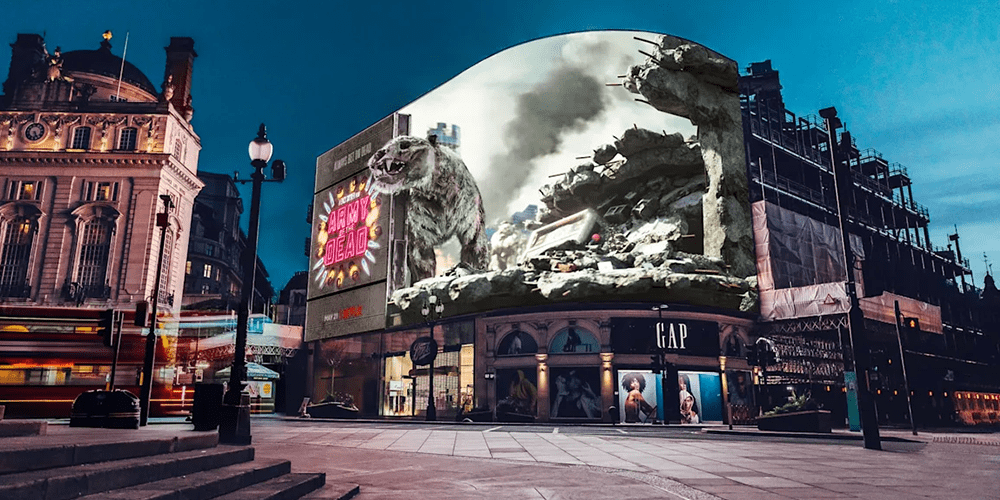
Piccadilly Lights, London: Ocean Outdoor documents projects using its DeepScreen format, including Walkers and Audemars Piguet. The examples show how different brands can use the same landmark surface with distinct visual treatments.
For your own 3D billboard brief, separate what belongs to the site from what belongs to the creative. Screen dimensions, surrounding architecture, and audience paths remain fixed. Product scale, pacing, lighting, and the reveal can change. Request site-specific production guidance before approving the storyboard.
03. United States Display Examples
Times Square, New York: Samsung’s campaign announcement also documents the tiger on a Times Square display. A multi-city campaign still needs a version suited to each screen. Reusing the same product model does not mean the final pixel layout or perspective can be reused unchanged.
When assessing US 3D billboard examples, identify the display owner and campaign source. Mechanical installations, ordinary LED animation, and composited social videos can all be described as “3D” online. Ask for original location footage before treating a clip as proof of a particular display capability.
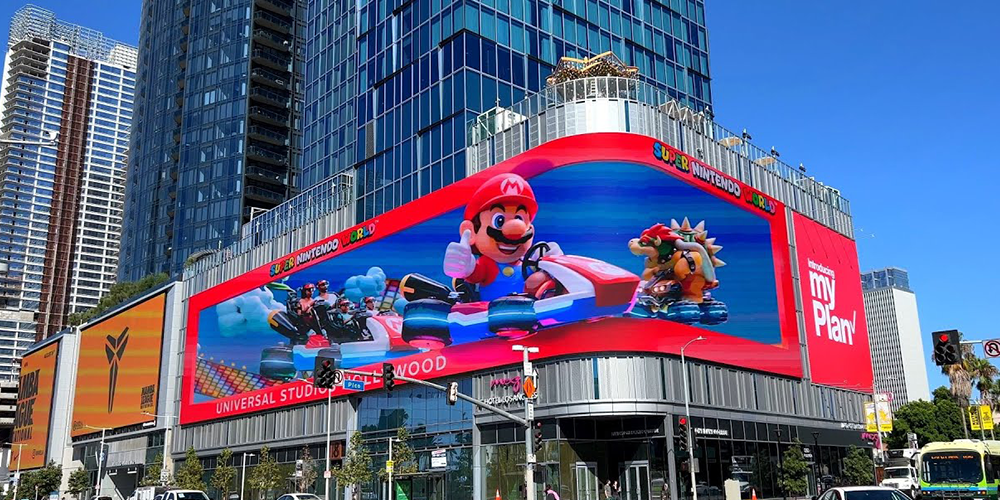
Use the existing image examples as creative inspiration. For a buying decision, request the operator’s current screen specification and production brief. Historic campaigns may no longer be playing, and an image alone cannot establish present availability, media price, or advertising performance.
5. Cost of 3D Billboard Advertising and ROI
There is no single 3D billboard cost because booking airtime, producing animation, and building a display are different purchases. For a campaign on an existing screen, request a dated media quotation and a separate creative scope. For ownership, include site work and operation.
Compare advertising LED board options, review LED display installation cost factors, and use the LED pixel pitch calculator for initial canvas planning.
| Purchase | Main cost components | Ask before comparing quotes |
|---|---|---|
| Media placement | Location, dates, loop share, dayparts, exclusivity | How many plays are contracted, and what happens after downtime? |
| Creative production | Concept, product models, animation, rendering, testing | How many revisions and screen adaptations are included? |
| Display ownership | LED equipment, control, structure, installation | Which site works and delivery charges are excluded? |
| Ongoing operation | Electricity, cleaning, service, replacement parts | Who operates the system and responds to faults? |
| Campaign support | Filming, landing page, research, paid promotion | Which costs are needed to measure the agreed objective? |
01. Calculating ROI without Inflating Results
For a sales-led campaign, calculate return using attributable incremental contribution after the cost of goods, then subtract the campaign cost. A before-and-after sales increase alone does not prove the 3D billboard caused it; promotions, seasonality, and other advertising may contribute.
Illustrative arithmetic, not a forecast: If an entirely hypothetical campaign costs $30,000 and produces $45,000 in incremental contribution before campaign expense, the return is ($45,000 − $30,000) ÷ $30,000 = 50%. The difficult part is validating the $45,000 attribution, not the formula.
For awareness campaigns, agree on brand-lift or recall research before launch. For media buying, compare cost per thousand impressions only when suppliers use compatible audience methods. Keep modeled audience exposure, measured website sessions, and qualified leads in separate report columns.
6. Future of 3D Displays in Outdoor Advertising
The practical direction for 3D billboard production includes reusable assets, faster creative iteration, and interactive experiences. Evaluate these options by production reliability and audience value rather than assuming every new tool will reduce costs.
01. AI-Assisted Animation
AI tools can assist with concept exploration and draft visual treatments. Final 3D billboard content still needs accurate geometry, consistent product details, appropriate asset rights, and human approval. A visually appealing concept image does not establish that the animation will map correctly to a real screen.
02. Interactive AR Experiences
A phone-based augmented reality experience can extend a campaign beyond the LED surface. Keep participation optional and the destination quick to load. If a QR code is used, place it where pedestrians can stop safely and test scanning at the real viewing distance.
03. Real-Time and XR Integration
Ocean Outdoor describes real-time game-engine interaction in its DeepScreen Alive offering. Such projects need clear operating rules: response latency, moderation, network failure behavior, and a fallback loop. Real-time rendering is an option, not a requirement for a conventional 3D billboard.
Before adopting an interactive feature, ask what it contributes to the message and how the operator will support it during the booked hours. A reliable prerecorded sequence may better suit a short launch with a fixed deadline.
7. How Businesses Can Use 3D Billboards
Plan a 3D billboard campaign around the decision you want viewers to make. A launch may prioritize recognition; a retail activation may prioritize store visits. Write that objective into the brief before choosing a screen or an animation style.
01. Plan for Visibility
Visit the location during the proposed campaign hours. Note the main walking direction, obstructions, stopping areas, and how long the screen stays visible. A busy junction does not guarantee that people see the full sequence from the correct angle.
| Decision | Evidence to collect | Acceptance question |
|---|---|---|
| Audience viewpoint | Site photographs from actual pedestrian positions | Can the main audience see both the product and the intended depth? |
| Screen geometry | Dimensions, elevation, corner shape, pixel template | Does the creative model match the booked display? |
| Message timing | Storyboard and loop duration | Is the brand clear to someone who joins halfway through? |
| Playback quality | On-screen test and uncut phone recording | Are scaling, seams, dark detail, and motion acceptable? |
| Launch readiness | Approved final file, schedule, fallback content | Who can resolve a playback fault before the booked launch? |
02. Create a Story, Not Just an Image
Structure the 3D billboard around a setup, a reveal, and a readable brand moment. Keep essential claims visible long enough to understand. Ask people unfamiliar with the project what they remember after one viewing. If they describe the effect but cannot name the product, revise the sequence.
03. Execute with the Right Partners
Assign the media operator, creative studio, hardware supplier, and installer clear responsibilities. Approve a low-detail test first, then the final render. Agree on file delivery deadlines, test slots, sign-off authority, and recovery steps for an incorrect upload or equipment fault.
04. Measure, Learn, and Improve
Use campaign-specific links or landing pages for attributable responses, while recognizing that many viewers will search later or use another device. Record a baseline before launch and document simultaneous campaigns. Ask the operator for proof-of-play records; these verify delivery, not the number of people who watched.
| Goal | Useful evidence | Interpretation limit |
|---|---|---|
| Delivery | Scheduled versus completed plays and uptime | A played spot is not proof of audience attention |
| Attention | Defined observation study or comparable research | One filmed crowd may not represent the whole campaign |
| Brand impact | Consistent pre/post or exposed/control survey | Report sample size and study limitations |
| Digital response | Tagged sessions, enquiries, qualified leads | Direct traffic and cross-device journeys remain incomplete |
| Commercial return | Incremental contribution versus full campaign cost | Separate attribution assumptions from confirmed transactions |
8. Why Choose EagerLED as Your 3D Billboard Manufacturer
EagerLED supplies outdoor LED display products that can support a 3D billboard project. Evaluate the proposed configuration against your location and creative requirements. The manufacturer provides the display foundation; successful campaign delivery also depends on content production and local implementation.
- Configuration: Request a cabinet drawing, native pixel map, corner detail, and control-system scope.
- Serviceability: Confirm which parts can be reached from the front or rear after installation.
- Image quality: Request representative playback with your planned content and brightness settings.
- Support: Agree on spare parts, warranty coverage, shipping responsibility, and response arrangements in writing.
For an initial 3D billboard enquiry, provide the site location, photographs, proposed dimensions, audience viewpoint, operating hours, and launch date. State whether the request covers hardware only, an installed system, or coordination with a creative partner.
01. Product Option: EA3D-VR Outdoor 3D LED Billboard
The EA3D-VR product page describes front and rear service and corner-display options. The published specification lists different pixel-pitch configurations. Confirm current model availability and the exact ordered specification before purchase.
An outdoor protection rating does not remove the need to review the complete installation, including cable entries, drainage, ventilation, and service access. Request project-specific documentation and an acceptance test. A product page alone cannot guarantee the performance of a complete 3D billboard at your site.
9. 3D Billboard FAQs
01. What is a 3D billboard and how does it work?
A conventional anamorphic 3D billboard uses perspective-designed video on an LED screen to suggest depth. Shadows, overlap, and a simulated frame help the effect. It needs no glasses, but the apparent shape changes as the viewer moves away from the designed viewing position.
02. How much does 3D billboard advertising cost?
Request separate quotes for media placement, animation, and campaign support. Location, dates, airtime, creative complexity, and screen adaptations affect the total. Buying and installing a display is a different budget from renting airtime. A short promotional slot and a sustained landmark campaign should not be compared as equivalent products.
03. Where can I see verified 3D billboard examples?
Start with the Cross Shinjuku Vision operator, Ocean Outdoor campaign pages, and brand announcements such as Samsung’s Tiger in the City. Check campaign dates and location details. A historic case study demonstrates a past installation; it does not confirm that the same advertisement is playing today.
04. How does 3D advertising differ from regular digital outdoor advertising?
Both can use LED screens and moving content. An anamorphic 3D billboard adds an illusion designed around screen geometry and a viewing position. Conventional digital creative may remain easier to read across wider audience angles. Choose the format according to the message, location, production budget, and measurement plan.
05. Can an existing flat LED screen show 3D billboard content?
Yes, a flat LED screen can show a perspective illusion when the content is designed for that screen and viewpoint. A corner is helpful for some compositions but is not mandatory. Test a rough scene on the actual display before committing to a finished animation.
06. Are viral 3D billboard videos always real?
No. Some show real LED installations playing CGI animation, while others add virtual objects to street footage in post-production. Look for operator confirmation, location details, and uncut recordings from multiple positions. The presence of CGI does not itself identify which production method was used.
10. Conclusion
A 3D billboard works when perspective, screen geometry, and the audience viewpoint support a clear advertising idea. Technical quality matters, but so do message timing, delivery reliability, and a realistic production brief.
Choose a location that fits your audience, approve an early screen test, and compare complete campaign budgets. Preserve a readable brand message outside the ideal viewing position.
Measure delivered plays, audience response, and commercial outcomes separately. Treat viral reach and increased sales as results to verify rather than benefits every 3D billboard automatically delivers.
To discuss a 3D billboard display with EagerLED, prepare your site photographs, screen dimensions, operating schedule, and creative objective, then request a project review. Those details make the proposal easier to compare and the campaign easier to deliver.