
2026-10-09T02:41:38+00:00October 9, 2026|Tags: 3D Billboard, LED Display Knowledge, Naked-Eye 3D|
2026-09-28T02:49:48+00:00September 29, 2026|Tags: FAQs NovaStar|
2026-09-22T02:47:54+00:00September 25, 2026|Tags: LED Display Knowledge|
The cost of LED display installation cannot be determined from screen area alone. A complete project can include the LED cabinets, video control equipment, mounting structure, electrical distribution, data cabling, freight, lifting equipment, installation labor, testing, spare parts, and training. The installation site determines how much of that work is necessary.
We do not publish a universal installation rate because structural conditions, electrical capacity, access, local labor, transport, permits, and commissioning requirements vary by project. A reliable figure requires an itemized quotation based on the actual site and delivery scope.
This guide separates display hardware from the complete installation scope, explains the factors that affect project cost, and provides a checklist for requesting comparable proposals.
Important: Structural design, electrical work, rigging, and work at height must comply with local regulations and should be completed by qualified professionals. Taxes, duties, permits, civil work, and unusual site conditions may not be included in an initial supplier scope.
Quick Answer: What Does LED Display Installation Cost?
Most buyers use “installation cost” to mean one of two things:
- Installation service cost: the structure, electrical work, cabling, lifting, labor, testing, and handover required to install equipment that has already been purchased.
- Complete installed project cost: the LED display hardware plus every item needed to deliver a working screen.
The second figure is usually more useful for budgeting. Installation service alone cannot be estimated accurately from screen area because a simple indoor wall and an outdoor freestanding structure have completely different engineering and access requirements.
| Project type | Typical installation setting | Main installation work |
|---|---|---|
| Indoor school, church, meeting room, or gym | Existing interior wall, recessed opening, or floor support | Wall frame, power, signal cabling, alignment, testing |
| Outdoor school field or advertising screen | Freestanding, pole-mounted, rooftop, or facade installation | Engineered steelwork, weather protection, lifting, electrical work |
| College arena or stadium display | High-level permanent structure with critical operation | Heavy structure, redundant control, high-capacity power, commissioning |
| Temporary event LED screen | Ground-supported or suspended event system | Transport, rigging, crew, setup, operation, dismantling |
The required scope varies because screen size is only one cost driver. Pixel pitch, mounting method, local labor, installation height, structural work, and delivery location can all change the final quotation.
1. Display Hardware Is Only Part of the Installed Project
A supplier may quote only the LED cabinets. That equipment scope can help compare similar configurations, but it does not show what is required to deliver a complete working installation.
The following comparison can support early planning without treating the display as the entire project:
| LED display configuration | Main planning focus | Typical installation implications |
|---|---|---|
| Indoor fine-pitch display | Close viewing, resolution, wall depth, and image quality | Precise frame tolerances, front-service access, ventilation, and careful alignment |
| Outdoor advertising display | Brightness, weather resistance, viewing distance, and operating hours | Engineered structure, power distribution, grounding, lifting, and safe maintenance access |
| Stadium or arena display | Long-distance visibility, reliability, live content, and venue integration | Heavy structure, redundant control, high-capacity power, commissioning, and remote monitoring |
| Premium broadcast LED | Camera performance, refresh rate, color consistency, and processing | Camera tests, calibration, synchronized signal workflows, and controlled lighting |
The display configuration alone does not include foundations, a supporting tower, wind-load calculations, power distribution, a crane, local labor, freight, or commissioning. These items must be confirmed from the project drawings and site conditions.
Use the LED pixel pitch calculator to compare screen dimensions, pitch, and resolution before requesting a formal configuration. A finer pitch increases pixel density and may increase both hardware and processing costs, but the smallest available pitch is not automatically the best choice for every viewing distance.
2. What Is Included in the Cost of LED Display Installation?
A clear proposal should divide the project into separate cost blocks. This makes quotations easier to compare and reveals exclusions before work begins.
2.1 LED cabinets, modules, and spare parts
The active display normally includes cabinets or frames, LED modules, receiving cards, power supplies, internal cables, and an agreed quantity of spare modules and components. Screen area, pixel pitch, brightness, refresh rate, cabinet material, ingress protection, and service method all affect this part of the price.
2.2 Video processing and control
The control scope may include a video processor, sending equipment, media player, input cards, signal converters, monitoring, and backup signal paths. A simple presentation screen requires less equipment than a broadcast venue with multiple sources, live cameras, 4K input, or scoreboard integration.
2.3 Supporting structure and mounting hardware
The structure transfers the display load safely to a wall, roof, floor, truss, pole, or foundation. Its cost depends on screen weight, installation height, service access, building conditions, local wind requirements, corrosion protection, and whether stamped engineering is required.
An existing wall should never be assumed to be suitable. The mounting surface, anchors, load path, tolerances, and maintenance clearance must be checked before fabrication.
2.4 Power distribution and data cabling
An LED display needs more than a nearby wall outlet. The electrical scope may include distribution panels, breakers, isolation, power cable, grounding, surge or lightning protection, cable trays, signal fiber, network equipment, and a route between the control location and the screen.
Electrical infrastructure should be sized from the manufacturer’s specified maximum connected load and local electrical code. Operating-cost estimates, by contrast, should use a defensible average load based on realistic brightness and content.
2.5 Installation labor and access equipment
Labor can include unloading, cabinet assembly, module alignment, cable termination, processor configuration, testing, and site cleanup. Scaffolding, boom lifts, cranes, rigging hardware, traffic control, night work, restricted working hours, and difficult loading access can increase the cost even when the screen itself is unchanged.
2.6 Packing, freight, and import expenses
Ask whether the quote includes export packing, flight cases, inland transport, international freight, insurance, customs clearance, import duties, taxes, and final delivery to the installation point. “Delivered to port” and “delivered and installed” are very different commercial scopes.
2.7 Configuration, testing, and commissioning
Commissioning should confirm cabinet mapping, image alignment, color and brightness uniformity, signal behavior, backup functions, and operation at the intended content settings. The handover may also include operator training, system documentation, configuration backups, an acceptance test, and a signed defect list.
2.8 Warranty and post-installation support
Compare the warranty period, covered components, labor responsibility, replacement-part shipping, response time, remote support, and local service availability. A low initial quotation can become expensive when it includes too few spares or makes the buyer responsible for every service visit.
3. A Practical Installed-Cost Formula
Use this model when building an early project budget:
Complete installed LED display cost = display hardware + control system + structure + electrical/data work + installation labor/access + freight/duties + spare parts + commissioning
Permits, professional engineering, civil work, taxes, content production, and long-term maintenance should be added when they are outside the supplier’s scope.
Do not compare only the final totals from two proposals. Put each quotation into the same categories and identify which party is responsible for every excluded item. One supplier may appear cheaper simply because the crane, electrical panel, steelwork, or local labor has been left for the buyer to arrange.
4. Indoor vs. Outdoor LED Display Installation Cost
4.1 Indoor LED wall installation
An indoor LED screen usually avoids outdoor foundations and weather protection, but the project still requires careful structural, electrical, and service planning.
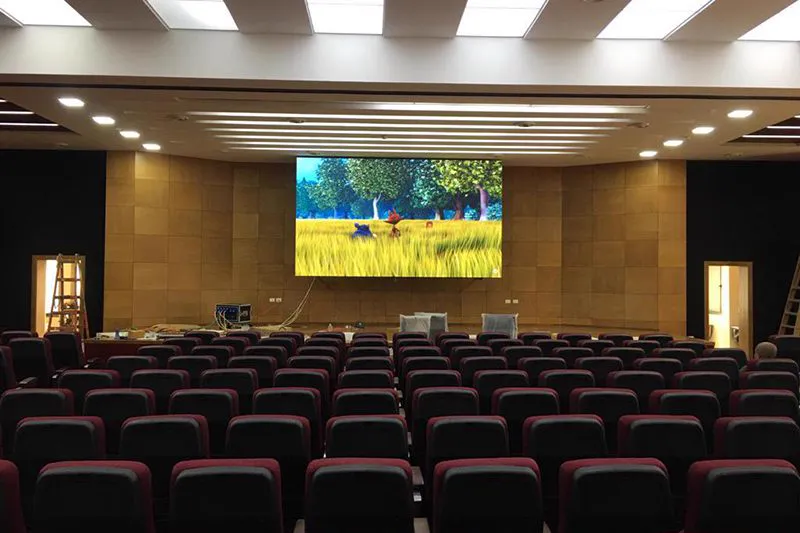
A finished wall-mounted indoor LED display in an auditorium.
Important indoor cost factors include:
- Wall strength, anchor design, and the flatness of the supporting frame.
- Recessed, surface-mounted, suspended, or floor-supported construction.
- Front-service or rear-service access and the depth available behind the screen.
- Ventilation, heat management, equipment-room requirements, and fire regulations.
- Fine pixel pitch, close viewing distance, camera use, and image-quality requirements.
- Protection of floors, walls, and occupied areas during installation.
- Restricted loading access, elevators, working hours, and site cleanup.
A front-service wall can cost more in hardware or frame design, but it may save valuable floor space and reduce future maintenance disruption.
4.2 Outdoor LED screen installation
An outdoor advertising LED board or stadium LED screen has a wider installation scope. The display and structure must suit sunlight, rain, dust, temperature changes, wind, corrosion, drainage, and safe maintenance access.
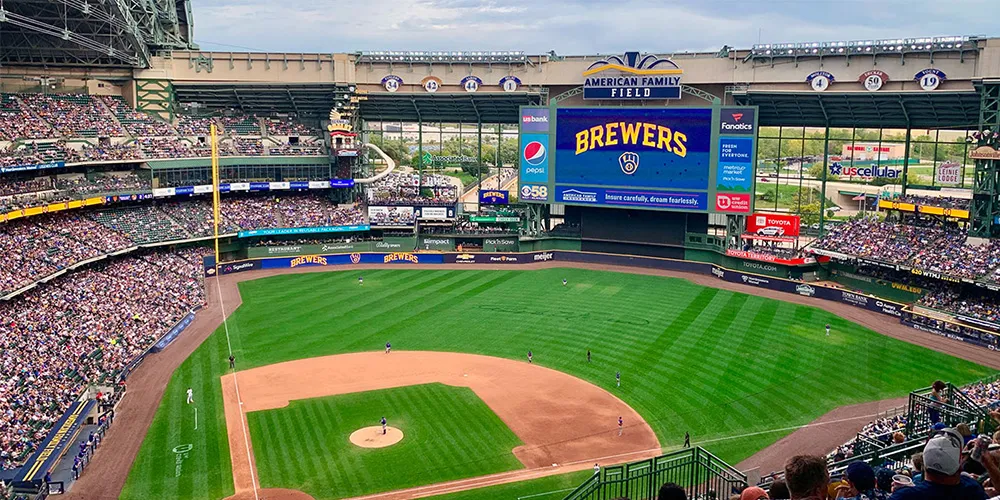
A permanent outdoor stadium display with supporting structure, power, control, and service requirements.
Outdoor budgets may need to include:
- Site survey, geotechnical information, structural calculations, and local approval.
- Foundations, poles, towers, steel frames, catwalks, ladders, and guardrails.
- Wind-load design, corrosion protection, drainage, and waterproof cable entries.
- High-brightness display hardware and automatic brightness control.
- Main power upgrades, grounding, surge protection, and lightning protection.
- Cooling or ventilation appropriate to the cabinet and local climate.
- Cranes, road closures, traffic management, high-level work, and fall protection.
- Remote monitoring, backup control, security, and scheduled maintenance access.
Outdoor installation is therefore not simply an indoor installation with weatherproof cabinets. The supporting infrastructure can represent a major part of the project.
5. How the Mounting Method Changes the Budget
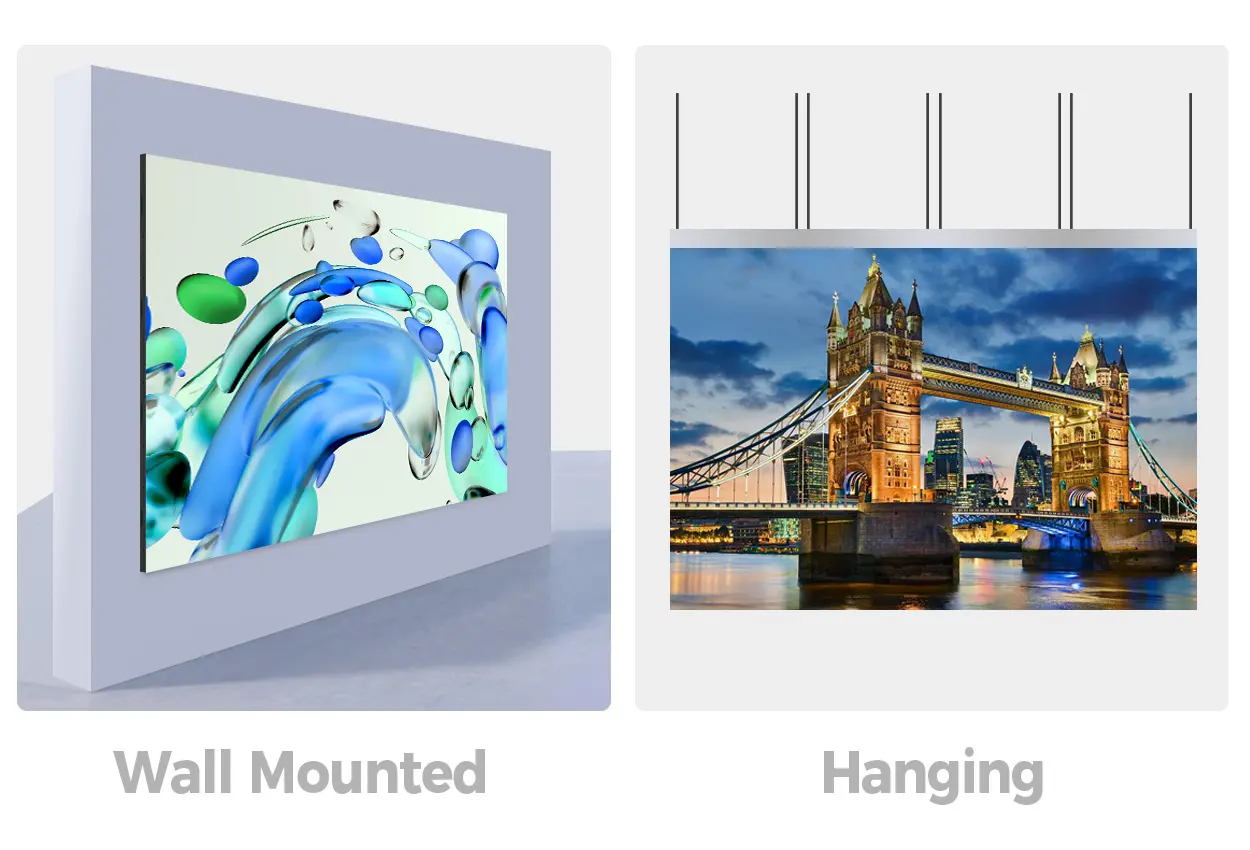
Wall-mounted and suspended displays require different load paths, access plans, and installation equipment.
5.1 Wall-mounted or recessed installation
A wall-mounted screen can be economical when the building is suitable, access is straightforward, and power and data are nearby. Costs rise when the wall requires reinforcement, the display must be recessed into finished architecture, tolerances are tight, or future service access has not been reserved.
Confirm the total display depth, frame depth, ventilation gap, edge finishing, service direction, and method for replacing modules before approving the structure.
5.2 Hanging or suspended installation
A suspended screen requires verified overhead capacity, rated rigging hardware, defined suspension points, secondary safety measures where required, and qualified riggers. The design must consider the complete suspended load, not only the cabinet weight.
Hanging work may also require lifts, scaffolding, truss, hoists, venue approval, and installation outside normal operating hours. These access costs can be significant for atriums, stages, exhibition halls, and sports venues.
5.3 Freestanding, pole-mounted, or rooftop installation
These installations often require the most site-specific engineering. Soil conditions, foundations, wind exposure, elevation, building loads, access platforms, drainage, lightning protection, and planning permission can all affect the final cost.
For a permanent roadside or building display, review the broader LED advertising screen solutions before selecting the cabinet. The screen specification and structural concept should be developed together.
5.4 Temporary and rental installation
A rental LED screen is designed for repeated setup and dismantling. The quotation may include transport, crew, ground support or rigging, ballast, power distribution, video processing, rehearsals, show operation, standby time, dismantling, travel, accommodation, and equipment insurance.
A one-day event can require multiple billable days because equipment and technicians may be needed for delivery, setup, testing, rehearsal, the live event, and removal. Compare rental proposals using the same screen size, pixel pitch, operating schedule, installation method, crew scope, and venue access assumptions.
6. The Main Factors That Change LED Screen Installation Cost
Screen dimensions and pixel pitch
More active area requires more cabinets, power, structure, transport volume, and labor. A finer pixel pitch increases the number of pixels and may require more processing capacity. Select pitch from actual viewing distance and content requirements instead of choosing by price alone.
Screen type and shape
A conventional flat wall is usually easier to fabricate and align than a corner, curve, column, or custom shape. A flexible LED display may require detailed drawings, custom framing, module mapping, curved finishing, and additional factory or site testing.
A transparent LED screen introduces other questions: glass dimensions, mullion positions, transparency, daylight brightness, cable concealment, viewing from both sides, and the effect of the installation on the facade.
Service access
Rear-service screens require space for technicians, safe access, and often a maintenance platform. Front-service screens can reduce structural depth but must still provide a practical method for removing modules, power supplies, and receiving cards. Poor access lowers the initial building cost only by moving expense and downtime into future maintenance.
Cameras and image-performance requirements
Studios, stages, conferences, sports venues, and livestreams may require high refresh rate, suitable scan design, low-brightness image quality, genlock or synchronized workflows, and testing with the intended cameras. This can change the cabinet, processor, calibration, and commissioning scope.
Redundancy and operating importance
A lobby screen and a live broadcast scoreboard do not need the same resilience. Critical projects may specify backup power, redundant signal routes, dual processors, spare cabinets, remote monitoring, and local response support. These measures increase initial cost but reduce the risk of visible failure.
Site access and project schedule
Restricted loading docks, narrow doors, limited elevator capacity, high installation positions, occupied buildings, union rules, night work, short shutdown windows, and remote locations all affect labor and logistics. Share this information before the supplier completes a quote.
7. Three LED Display Project Scope Examples
The examples below show how installation scope changes between common projects. They do not provide public pricing; an accurate quotation depends on the final specification, country, labor market, taxes, and site conditions.
Example 1: 24 m² indoor wall for a church or meeting hall
| Scope item | What should be confirmed |
|---|---|
| Indoor LED cabinets and spare parts | Pixel pitch, active dimensions, service method, brightness, refresh rate, and spare quantity |
| Processor and control equipment | Content sources, input formats, required resolution, camera use, and backup needs |
| Wall frame and installation labor | Wall condition, mounting depth, tolerances, ventilation, working hours, and access |
| Power distribution and data cabling | Available capacity, cable routes, grounding, control location, and local electrical work |
| Freight, testing, and commissioning | Delivery point, unloading access, alignment, acceptance test, training, and handover documents |
This scope assumes normal wall access and no major building reinforcement. Recessed architectural finishing, premium fine-pitch hardware, camera requirements, or restricted working hours would require additional planning.
Example 2: 72 m² outdoor advertising screen
| Scope item | What should be confirmed |
|---|---|
| Outdoor LED cabinets and spare parts | Pixel pitch, brightness, ingress protection, cabinet design, cooling, and spare quantity |
| Engineered steel structure and foundation | Wind conditions, soil data, elevation, maintenance access, corrosion protection, and local approval |
| Power, grounding, and signal infrastructure | Connected load, cable routes, distribution, surge protection, lightning protection, and fiber distance |
| Processor and remote control | Content workflow, remote monitoring, scheduling, backup signal, and network requirements |
| Crane, installation labor, and site access | Lifting plan, road access, traffic control, work height, site induction, and local crew responsibility |
| Freight, testing, and commissioning | Shipping terms, customs boundary, final delivery, calibration, acceptance testing, and training |
Permits, land work, utility-company requirements, taxes, and unusual foundation conditions must be identified separately in the quotation.
Example 3: 120 m² stadium video display
| Scope item | What should be confirmed |
|---|---|
| Outdoor LED hardware and spare stock | Viewing distance, content, brightness, camera performance, cabinet layout, and critical spares |
| Structure and civil work | Venue load paths, wind design, foundation or building connection, catwalks, guardrails, and service access |
| Redundant processing and control | Backup processors, signal routes, monitoring, failover behavior, and scoreboard or broadcast integration |
| High-capacity power and data | Main service capacity, distribution, backup power, grounding, fiber routes, and control-room upgrades |
| Installation, lifting, and safe access | Crane plan, venue schedule, work-at-height controls, restricted access, and coordination with other contractors |
| Freight, calibration, training, and handover | Delivery sequencing, storage, calibration, acceptance criteria, operator training, and documentation |
Scoring integration, premium broadcast performance, extensive foundations, ribbon displays, control-room upgrades, and long-term service contracts should be defined before suppliers finalize the quotation.
8. Hidden Costs and Common Quote Exclusions
Before approving a proposal, check whether the following items are included, excluded, or assigned to a local contractor:
- Site survey, measured drawings, structural engineering, and professional stamps.
- Planning approval, sign permits, building permits, inspections, and application fees.
- Demolition, wall reinforcement, foundations, drainage, roofing, and architectural finishing.
- Main electrical service upgrades, distribution panels, generators, UPS equipment, and utility charges.
- Signal fiber, network switches, internet service, control-room equipment, and cybersecurity requirements.
- Cranes, lifts, scaffolding, rigging, traffic control, road closures, and security.
- Union labor, overtime, night work, travel, accommodation, visas, and site induction.
- Export packing, freight insurance, customs clearance, duties, sales tax, and VAT.
- Content creation, content-management software, licenses, media players, and operator services.
- Calibration, acceptance testing, training, documentation, and configuration backups.
- Spare modules, spare power supplies, receiving cards, repair tools, and storage.
- Preventive maintenance, cleaning, insurance, electricity, replacement labor, and future refurbishment.
The word “turnkey” is not enough. Ask the supplier to describe the exact delivery boundary in writing.
9. Information Needed for an Accurate Installation Quote
A complete project brief reduces assumptions and helps different suppliers quote the same scope.
Site and application
- Project address and final delivery destination.
- Indoor, protected outdoor, or fully exposed outdoor environment.
- Intended use: advertising, presentation, worship, sports, broadcast, retail, exhibition, or live event.
- Photos, videos, architectural drawings, and dimensions of the installation area.
Screen requirements
- Required active width and height, or maximum available space.
- Closest and farthest viewing distances.
- Preferred aspect ratio, resolution, or content format.
- Ambient light, operating hours, camera use, and brightness requirements.
- Flat, curved, corner, transparent, flexible, or custom display shape.
Installation conditions
- Wall-mounted, recessed, suspended, freestanding, pole-mounted, rooftop, or temporary installation.
- Installation height, mounting surface, structural information, and access restrictions.
- Front or rear maintenance preference and available service space.
- Existing power capacity, control-room location, and power/data cable routes.
- Crane, lift, scaffolding, rigging, loading dock, elevator, and working-hour limitations.
Commercial scope
- Required delivery date, installation period, and opening or event date.
- Items to be supplied locally and items expected from the LED display supplier.
- Freight terms, customs responsibility, taxes, permits, commissioning, and training.
- Spare-parts quantity, warranty coverage, response time, and maintenance expectations.
For an exhibition project, also provide the build schedule, stand drawing, venue rules, rigging limits, and dismantling deadline. See the exhibition LED screen guide for the relevant display format.
10. Copy-and-Send LED Display Quote Request
Use the following template when contacting a supplier:
Project location:
Indoor or outdoor:
Application:
Required active screen width and height:
Closest and farthest viewing distance:
Mounting method and installation height:
Front or rear service access:
Content sources, resolution, and camera use:
Available power and control-room location:
Site photos or drawings attached:
Required delivery and installation date:
Destination country and city:
Please quote separately: LED hardware, control equipment, spare parts, structure, power/data work, freight, installation, testing, training, warranty, and all exclusions.
11. How to Reduce Cost Without Creating a Weak Installation
Choose pixel pitch from viewing distance
Buying a finer pitch than the audience can appreciate increases hardware and processing cost without necessarily improving the practical result. Compare physical size and resolution with the calculator, then confirm the choice using sample content and the closest viewing position.
Finalize the site survey early
Late discoveries about wall strength, power capacity, access, or local approval create redesign and delay. A site survey before the final quotation allows the display, structure, electrical work, and installation sequence to be planned as one system.
Keep the first design buildable
A standard flat format with proven cabinet dimensions is usually more economical than a highly customized shape. Use custom curves, transparency, or architectural integration when they create clear business value, not simply because they are technically possible.
Compare identical quote scopes
Issue one written brief to every supplier. Require active dimensions, pixel pitch, brightness, refresh rate, structure, control system, power, installation, freight, spares, commissioning, and warranty to be shown separately. This is the most reliable way to identify a genuinely lower project cost.
Plan maintenance before installation
Accessible modules, documented cable routes, labeled components, adequate spares, and safe working space reduce future downtime and labor. Removing these items from the first budget can make the lifetime cost higher.
12. LED Display Installation Cost FAQ
How much does it cost to install an LED display?
There is no universal installation fee. The amount must be calculated from the display specification, structure, electrical scope, site access, lifting, labor, freight, commissioning, and local project requirements. Send the installation location, screen dimensions, mounting method, site photos or drawings, and delivery scope to receive an itemized quotation.
Can I calculate the installed cost from screen area?
No. Screen area helps define the hardware quantity, but it cannot represent the complete installed cost. Structure, foundations, power, control equipment, freight, crane access, and local labor do not increase in a simple linear relationship with active screen area.
Is indoor LED display installation cheaper than outdoor installation?
Indoor installation is often less complex because it does not require weatherproofing, wind-load design, or outdoor foundations. However, a fine-pitch indoor wall with architectural integration, camera requirements, restricted access, or major wall reinforcement can still have a high installed cost.
What is the most expensive part of an outdoor LED installation?
The answer depends on the site. LED hardware may be the largest line item, but an engineered steel structure, foundations, utility upgrades, cranes, civil work, and local installation can together equal or exceed the hardware cost on difficult projects.
Does the supplier install the screen?
Some suppliers provide hardware only, some provide remote guidance or a supervisor, and others offer a complete installation through their own team or local partners. Confirm who is responsible for engineering, permits, structure, electrical work, lifting, labor, testing, and warranty service before signing the order.
How long does LED screen installation take?
The on-site screen assembly may take days, but the complete project can take weeks or months when design, approval, fabrication, foundations, electrical work, shipping, and venue scheduling are included. Ask for a schedule that identifies dependencies and the party responsible for each task.
Should I use front-service or rear-service cabinets?
Front-service cabinets suit shallow wall-mounted or recessed installations where rear access is unavailable. Rear-service cabinets can be practical when a safe maintenance corridor or platform exists. The correct choice depends on structure depth, technician access, module replacement, ventilation, and lifetime maintenance cost.
Is it cheaper to rent an LED screen for an event?
Rental is usually more practical for one event or occasional use because it avoids permanent structure, storage, and ownership maintenance. Frequent events may justify buying a portable system. Compare the complete rental schedule, including transport, setup, rehearsals, technicians, show days, dismantling, and insurance.
Conclusion: Compare the Complete Installed Scope
The cost of LED display installation becomes manageable when the project is divided into clear parts. Start with the application, screen dimensions, viewing distance, site conditions, and mounting method. Then separate display hardware from control, structure, electrical work, labor, logistics, commissioning, and long-term support.
For product planning, compare our indoor LED screens, rental LED screens, advertising LED boards, and stadium LED screens. Send the project location, target size, viewing distance, mounting method, site photos or drawings, schedule, and destination to request an itemized quotation.