

2026-09-17T03:16:22+00:00September 20, 2026|Tags: LED Display Knowledge|
2026-09-15T03:13:01+00:00September 15, 2026|Tags: LED Display Knowledge|
2026-09-17T06:25:39+00:00September 8, 2026|Tags: LED Display Knowledge|
Choose LED display dimensions from the available space, audience sightlines and content. Then calculate the native pixel resolution and check it against the controller capacity. Physical width and height, pixel pitch, resolution and aspect ratio are related, but they are not interchangeable.
This guide explains cabinet-based sizing with worked examples. Use the LED pixel pitch calculator to compare options after confirming the exact cabinet specifications.
Table of Contents
1. What is the LED display size?
LED display size means the active screen width and height. The cabinet or module dimensions and the number installed determine this physical area. Pixel pitch determines how many pixels fit within that area; it does not by itself specify the overall screen size.
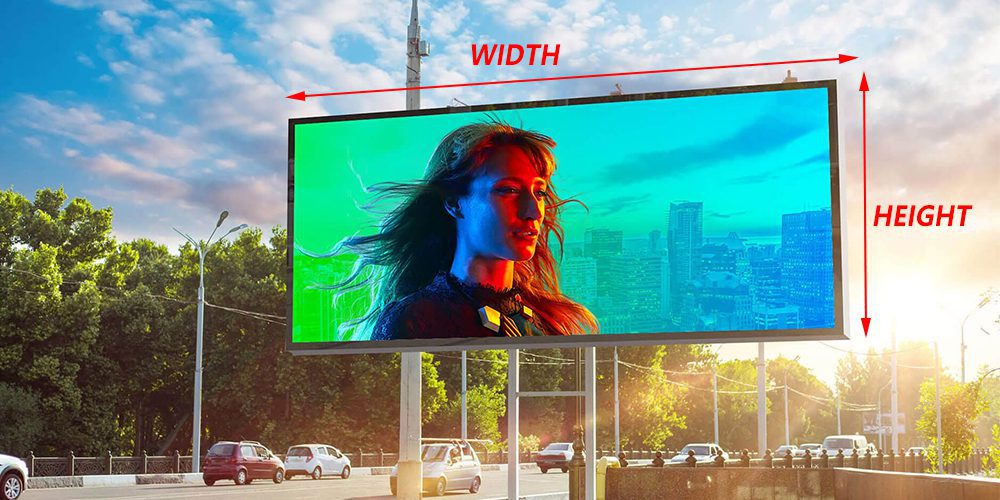
A modular wall is assembled in the dimensions supported by its cabinets or modules. Record the active display area separately from the frame, maintenance clearance and mounting structure. Two screens with the same physical dimensions can have different resolutions when their pixel pitches differ.
2. Common LED display sizes and application scenarios
LED Display Size plays a crucial role across a wide range of applications, from commercial and public spaces to entertainment environments.
Choosing the right LED Display Size can significantly enhance visual experiences and optimize budget allocation.
2.1 Small LED Display Size
Application scenarios: Retail signage, small meeting rooms, exhibition booths, store windows
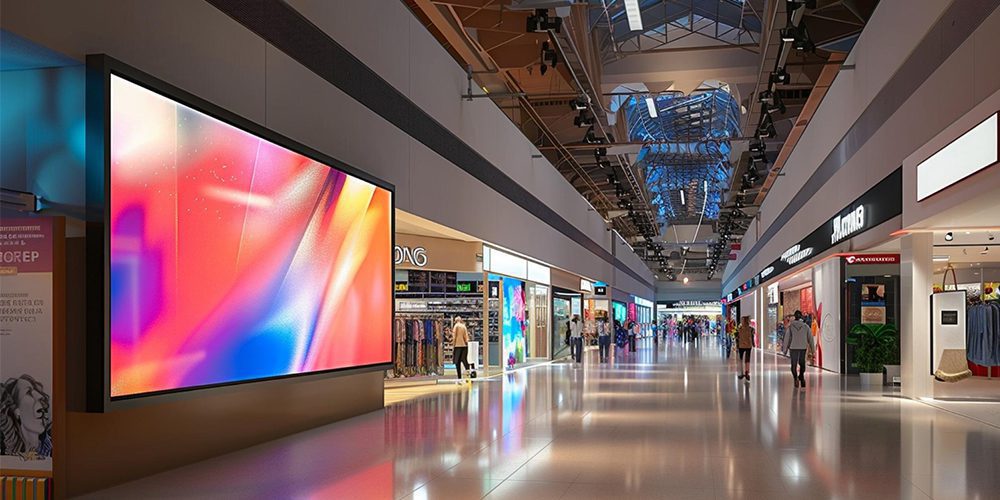
Designed for close viewing, small LED displays are ideal for indoor applications where space is limited but high resolution is required. They are compact and flexible to install, and are often used to display promotional information, brand logos, or conference content.
Common pixel pitches: P2.5mm, P2mm, P1.25mm
2.2 Medium LED Screen Size
Application scenarios: shopping mall atrium, stage background, church podium, company exhibition hall, auditorium multimedia screen

Medium-sized LED displays are suitable for environments with medium viewing distances and are usually used as visual focal points or background displays. They can be used to display static content, as well as support video playback, live broadcasts, and real-time interactions.
Common pixel pitch: P3.91mm, P4mm, P6mm
2.3 Large LED display
Application scenarios: outdoor billboards, stadiums, station/airport information screens, city squares, concert main screens
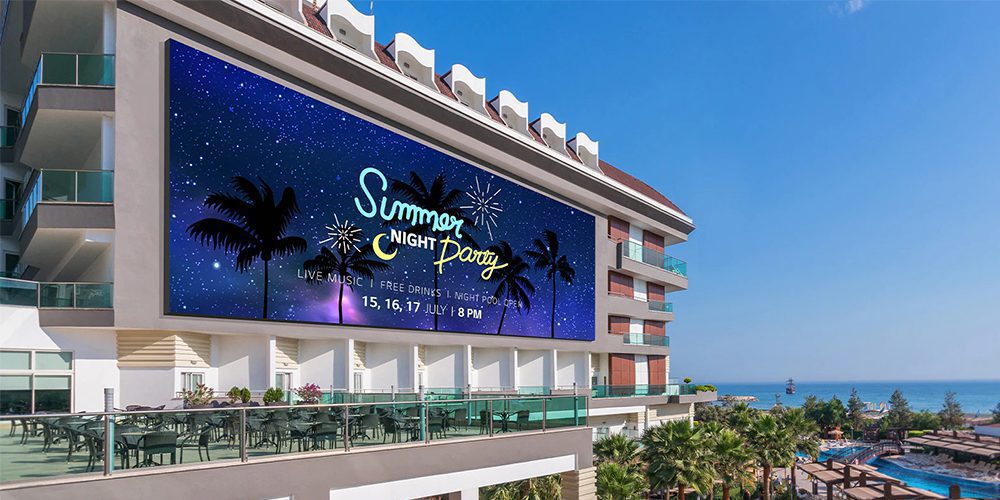
Large walls are used for stage backdrops, public information and outdoor advertising. There is no universal minimum viewing distance for this size category. Choose pitch from the nearest viewer and required detail; a physically large wall can still use fine-pitch LEDs.
3. Standard LED display size
An LED display is composed of modules and cabinets, and both parts typically follow standardized dimensions. A well-designed LED Display Size standard not only simplifies project planning and design but also greatly improves installation and maintenance efficiency.
Typically, LED Display Size standards are discussed from two perspectives: LED module size and LED cabinet size.
3.1 LED module size
LED modules are the most basic unit components of LED displays, usually composed of multiple pixel points arranged and connected through circuit boards. The choice of module size directly affects the overall size, resolution and clarity of the final display.
Module formats include 320 x 160 mm, 250 x 250 mm, 192 x 192 mm and other manufacturer-specific sizes. The available pixel pitch and pixel matrix depend on the exact product.
Equal dimensions do not mean interchangeable modules. Before replacing a module, verify its mounting points, pixel matrix, scan mode, driver IC, voltage, connector pinout, receiving-card configuration and calibration. Obtain compatibility confirmation from the supplier; do not assume modules from different manufacturers can be mixed.
3.2 LED Cabinet Size
The LED cabinet is a structural unit composed of multiple LED modules, usually with power supply, receiving card, heat dissipation structure and other accessories, which is the actual installation and transportation unit. Standardized cabinet size facilitates quick installation and disassembly, especially in the rental market.
Common cabinet formats include 500 x 500 mm, 500 x 1000 mm, 640 x 480 mm and 960 x 960 mm. Availability and compatible pitches vary by product. Curving and flying are permitted only for cabinets and support systems designed for those uses.
4. Factors affecting the size of LED screens
There are many factors that influence the LED Display Size, all of which directly determine the screen’s actual visual performance, installation method, and overall project cost. When planning an LED display project, fully considering these key factors will help achieve the desired visual presentation.
4.1 Actual space size of the installation site
The LED Display Size must first be compatible with the physical constraints of the installation environment. Whether it’s a wall, stage backdrop, or outdoor billboard, the available space dictates the maximum screen size. For example, indoor conference rooms are limited by ceiling height and wall width, which typically only allow for small or medium LED Display Sizes. In contrast, outdoor squares or large stadiums can accommodate large or even extra-large LED displays.
4.2 Viewing Distance and Readability
Screen size determines how large text and images appear to the audience. Pixel pitch affects visible pixel structure and available detail. A longer viewing distance may allow a coarser pitch, but does not require it. A large close-viewed screen is possible when the pitch and content suit that distance.
Test the smallest text from the farthest seat and visible pixel structure from the nearest seat. For indoor applications, compare the indoor LED screen guide.
4.3 LED dot pitch (pixel pitch)
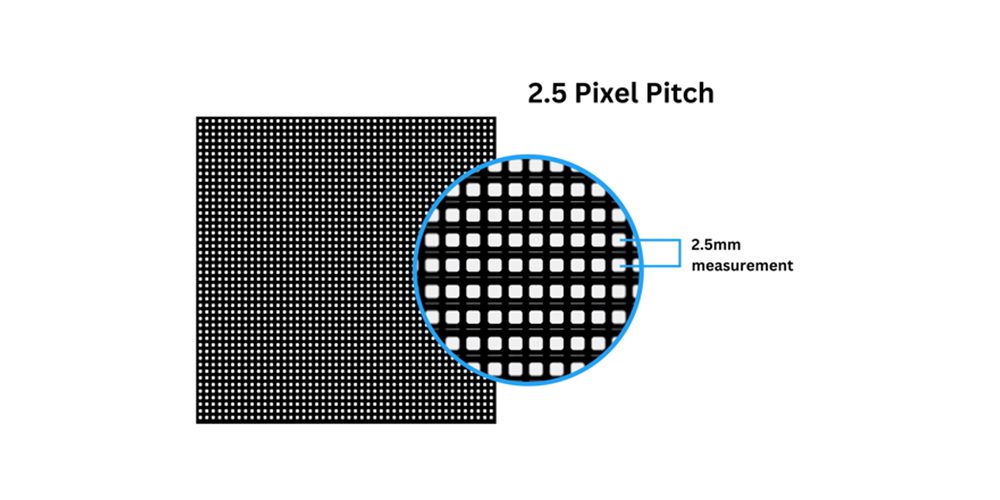
Pixel pitch refers to the distance between the centers of two adjacent pixels and is commonly expressed as a “P” value, such as P2.5 or P3.91. The smaller the pitch, the higher the pixel density and image clarity. At the same resolution, a smaller pixel pitch allows for a smaller LED Display Size, while a larger pitch requires a larger screen to achieve similar clarity. Therefore, pixel pitch is one of the core parameters that directly influence the selection of LED Display Size.
4.4 Content Display Requirements
Video does not automatically require a physically larger screen than text. Match the content canvas and aspect ratio to the native LED resolution. Small text, detailed diagrams and spreadsheets can require more pixels than simple video imagery. Decide whether unmatched content will be letterboxed, cropped or rescaled before installation.
4.5 Installation method (fixed installation or rental installation)
The installation method also impacts the required LED Display Size. Fixed installations are designed for long-term use and focus more on structural integrity and aesthetics. In contrast, rental LED displays require standardized dimensions for easy assembly and disassembly—typically using 500×500mm or 500×1000mm cabinets—resulting in more standardized overall LED Display Sizes.
4.6 Project Budget
The larger the LED Display Size, the more LED modules, cabinets, power supplies, control systems, and other components are required—leading to a significant increase in overall cost. Therefore, budget constraints often become one of the key factors in determining the appropriate LED Display Size in real-world projects. Striking a reasonable balance between project requirements and budget helps in identifying the most suitable LED Display Size solution.
5. How to Calculate LED Display Size?
Calculate physical dimensions first, then native resolution and total pixels. For a cabinet build, confirm the actual cabinet pixel matrix instead of relying on a rounded pitch name.
Worked Example: 4 m x 2.5 m Wall
- Assume 500 x 500 mm cabinets with exactly 200 x 200 pixels each (P2.5).
- Use 8 cabinets across and 5 high: 40 cabinets in total.
- Width = 8 x 500 = 4,000 mm; height = 5 x 500 = 2,500 mm; area = 10 square meters.
- Resolution = 8 x 200 by 5 x 200 = 1,600 x 1,000 pixels, or 1,600,000 pixels in total.
- The aspect ratio is 8:5, not 16:9. Agree how 16:9 content will fit without distortion.
- Check controller total loading, each output port, cable mapping, cabinet power and structural load separately.
This is a calculation example, not a specification for every 500 mm cabinet. Review the rental LED wall booking checklist for delivery and installation planning.
5.1 Measure by width and height (standard rectangle method)
This is the most basic and intuitive approach. It involves directly measuring the physical width and height of the LED display area and is suitable for standard rectangular displays.
Example:
If you plan to install a screen that is 3000mm wide and 2000mm high:
LED Display Size = 3000mm × 2000mm
Formula:
Width (W) = Actual measured width (mm)
Height (H) = Actual measured height (mm)
LED Display Size = Width × Height
5.2 Measuring Using Module Dimensions
An LED display is assembled from multiple modules. You can calculate the overall LED Display Size by multiplying the module dimensions by the number of modules spliced together.
Example:
If one LED module measures 320mm × 160mm and there are 8 modules horizontally and 6 vertically:
Total Width = 320mm × 8 = 2560mm
Total Height = 160mm × 6 = 960mm
LED Display Size = 2560mm × 960mm
Formula:
Total Width = Module width × Number of horizontal modules
Total Height = Module height × Number of vertical modules
LED Display Size = Total Width × Total Height
5.3 Calculating by Cabinet Size and Quantity
The LED cabinet is a structural unit containing multiple modules and is the basic installation and transport unit. This method is ideal for fixed installation or rental screen projects.
Example:
If each cabinet measures 500mm × 1000mm and you use 4 horizontally and 3 vertically:
Total Width = 500mm × 4 = 2000mm
Total Height = 1000mm × 3 = 3000mm
LED Display Size = 2000mm × 3000mm
Formula:
Total Width = Cabinet width × Number of horizontal cabinets
Total Height = Cabinet height × Number of vertical cabinets
LED Display Size = Total Width × Total Height
5.4 Calculating by Pixel Pitch and Pixel Count
This method is ideal for situations where precise resolution control is required, such as video playback or high-definition content display.
Example:
If an LED display has a resolution of 1024 × 512 pixels and the pixel pitch is 2.5mm:
Width = 1024 × 2.5mm = 2560mm
Height = 512 × 2.5mm = 1280mm
LED Display Size = 2560mm × 1280mm
Formula:
Width = Horizontal pixels × Pixel pitch
Height = Vertical pixels × Pixel pitch
LED Display Size = Width × Height
5.5 Curved and Irregular Screens
Separate the bounding dimensions, active display area and content canvas. A 4 m diameter circle fits in a 4 x 4 m bounding square, but its circular area is approximately 12.57 square meters, not 16. The installed modules and any masking determine the real active pixels.
For a curved wall, specify the arc length, radius, height and cabinet arrangement. Use the approved drawing and pixel map for final dimensions rather than treating every shape as a filled rectangle.
6. Different units of LED Display Sizes
LED Display Size can be expressed in various units. Depending on the region, application scenario, and industry standard, the units used to measure LED Display Size may vary. Understanding the conversion between these units is crucial for ensuring project compatibility, screen accuracy, and proper content scaling.
This section explores how common units—millimeters (mm), centimeters (cm), meters (m), feet (ft), inches (inch), and pixels—are applied in measuring LED Display Size, along with their conversion methods.
6.1 LED Display Sizes in Millimeters (mm)
Millimeter is the most commonly used unit for LED Display Size in the industry. Whether designing LED modules, cabinets, or full screens, millimeters are typically the base measurement.
Common LED module and cabinet sizes are as follows:
Example module dimensions: 320 x 160 mm; 250 x 250 mm; 192 x 192 mm.
Example cabinet dimensions: 500 x 500 mm; 500 x 1000 mm; 640 x 480 mm; 960 x 960 mm.
These are independent examples, not a compatibility table.
Most LED display screens are designed based on millimeters, so this is one of the most important reference dimensions when selecting and installing them.
6.2 Dimensions in Centimeters
Centimeters = millimeters / 10. For example, 960 x 960 mm equals 96 x 96 cm. Convert width and height separately.
A 500 x 1000 mm cabinet measures 50 x 100 cm, while a 640 x 480 mm cabinet measures 64 x 48 cm. Dimensions alone do not identify its pixel pitch or resolution; consult the exact model datasheet.
Expressing the size of LED display screens in centimeters can help non-professionals understand the size of the screen more intuitively.
6.3 LED Display Sizes in Meters (m)
For large projects, the size of LED display screens is often expressed in meters (m), which is especially suitable for scenes such as billboards, outdoor large screens, and stage backgrounds.
Meter = millimeter ÷ 1000
Example:
9600mm × 5400mm = 9.6m × 5.4m
3840mm × 2160mm = 3.84m × 2.16m
Meters are particularly common in construction drawings, site measurements and rental plans, helping to quickly understand the overall LED display size range.
6.4 LED Display Sizes in Feet
In North America, the United Kingdom and other countries, feet (ft) is a common unit for describing the size of LED displays, especially in stage rental, building facades and sports stadium projects.
Feet = Meters × 3.281
Example:
4m × 3m LED screen ≈ 13.1ft × 9.8ft
12m × 6m advertising screen ≈ 39.4ft × 19.7ft
In event planning and venue layout, it is very practical to use feet to estimate the size of the LED display.
6.5 Width, Height and Diagonal in Inches
Inches = millimeters / 25.4. A 1,920 x 1,080 mm active area is approximately 75.6 x 42.5 inches. Its diagonal is about 86.7 inches, calculated from the square root of width squared plus height squared. Width in inches is not the same as the advertised diagonal size.
6.6 Native Resolution in Pixels
Pixel pitch is spacing in millimeters, not a unit of overall screen size. Calculate width in pixels = active width in mm / exact pitch in mm, and repeat for height.
A 3,840 x 2,160 mm active area at exactly P4 has 960 x 540 pixels, not 4K resolution. For products labeled with rounded pitch values such as P3.91, use the cabinet pixel matrix to obtain the exact result.
7. LED display size ratio
When choosing an LED display, it is not just about “how big” that matters, but more importantly, the aspect ratio of the LED display. The aspect ratio determines the visual presentation of the screen, content compatibility, and overall spatial adaptability, and is the core factor that affects the size configuration and actual effect of the LED display.
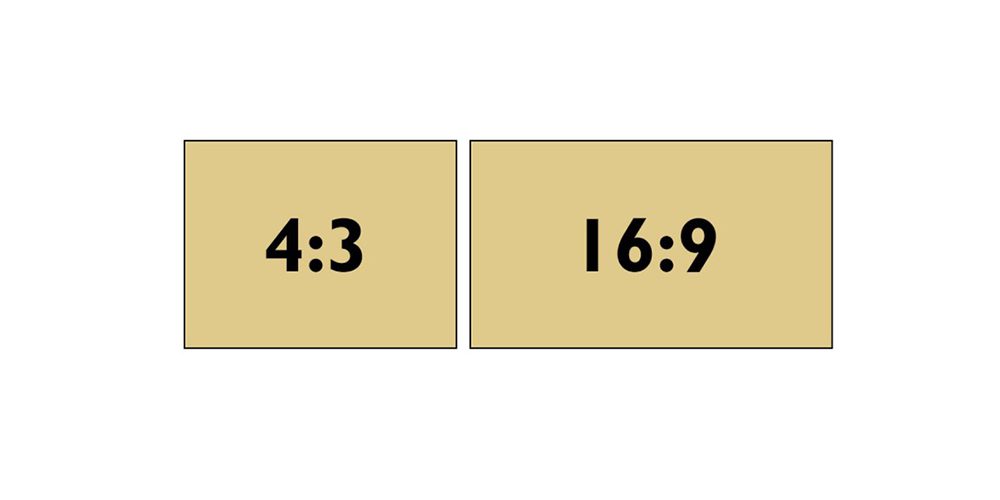
7.1 16:9 LED display size ratio
If you are not sure which ratio to choose, 16:9 is the most common and recommended LED display size ratio. It is the industry standard for today’s video, conference systems, advertising displays and other scenes, and it perfectly fits modern HD (1080p) and UHD (4K/8K) content.
| Size ratio | Common resolutions | Application Scenario |
| 16:9 | 1920×1080 (Full HD), 3840×2160 (4K), 7680×4320 (8K) | Video wall, conference screen, stage background, outdoor advertising LED display, indoor digital signage |
A 16:9 wall matches the shape of standard 16:9 video, but is not automatically Full HD or 4K. Check the native pixel count and the processor scaling settings. Matching aspect ratio avoids shape distortion; sufficient resolution determines available detail.
7.2 4:3 LED display size ratio
Before 16:9 became mainstream, 4:3 was the early mainstream video and display ratio. Although it is less common now, it is still used in some scenarios where the LED display size is narrow or needs to be compatible with traditional content.
| Size ratio | Common resolutions | Application Scenario |
| 4:3 | 1024×768 (XGA), 1600×1200 (UXGA) | Teaching LED display, government agencies, industrial control panels, traditional projection replacement screens |
Choose 4:3 when it matches the intended content and available space. At the same width it is taller than a 16:9 screen, so it is not inherently better for low ceilings. Test actual presentation files before selecting the final cabinet grid.
7.3 Other LED display size ratios
Sometimes, standard size ratios cannot meet complex or creative application requirements. Here are several common non-standard LED display size ratios, each with its own unique advantages:
| Size ratio | describe | Common Applications |
| 21:9 (Ultrawide) | Similar to cinema screen ratio, providing immersive experience | High-end theater, e-sports stage, immersive exhibition hall, luxurious conference room |
| 32:9 (Extremely Wide) | For multi-task data display or wide-angle monitoring | Command center, financial screen, dispatch center, stock exchange |
| 1:1 (square) | Unconventional but artistic proportions for digital signage | Retail windows, fashion advertising, social media video displays, LED poster screens |
| Custom scale | Can be designed arbitrarily according to project requirements, such as special-shaped screens and curved screens | Building exteriors, interactive exhibitions, stage design, brand launches |
8. In conclusion
In general, understanding and choosing the right LED display screen size ratio is a key step in creating an efficient visual experience. Different application scenarios and content forms have different requirements for the ratio – whether it is the classic 16:9, traditional 4:3, or creative 1:1 and ultra-wide ratios, finding the right size can maximize the effect of the LED display.
After reading this guide, you should now have a solid grasp of how LED display sizes affect visual impact, installation, and budget planning.
Still unsure which LED screen size is best for your project? Contact EagerLED today and get expert guidance on selecting the optimal LED display size based on your venue, application, and content goals. Let us help you bring your vision to life.

 Transparent LED Screen: Retail Window Selection and Installation