

2026-09-17T03:16:22+00:00September 20, 2026|Tags: LED Display Knowledge|
2026-09-15T03:13:01+00:00September 15, 2026|Tags: LED Display Knowledge|
2026-09-17T06:25:39+00:00September 8, 2026|Tags: LED Display Knowledge|
SMD and COB are the two packaging technologies behind almost every modern LED video wall. SMD solders individual red, green and blue lamp beads onto the PCB; COB bonds the LED chips directly to the board and seals them under a protective resin layer. The choice changes how a screen looks up close, how much abuse it survives, and what it costs to buy, run and repair. This guide compares SMD vs COB LED technology on image quality, durability and cost, with side-by-side tables and indicative 2026 pricing, so you can specify the right screen for your next project.
Table of Contents
1. Quick Comparison: SMD vs COB LED at a Glance
Both technologies use the same RGB LEDs and the same Novastar or Colorlight controllers, so the difference is not resolution or peak brightness. It is packaging, and packaging is what determines contrast, impact resistance, service method and price. The table below summarizes the practical gaps that matter most during specification; the sections that follow examine each one in detail.
| Decision factor | SMD LED display | COB LED display |
|---|---|---|
| Packaging | Individual RGB lamp beads soldered on the PCB | LED chips die-bonded directly on the PCB, sealed under resin |
| Common pixel pitch | 0.9 mm to 10 mm and above | 0.4 mm to 1.8 mm, plus 2.5 mm and above |
| Surface | Grid of visible lamp beads; black masks cut reflection | Seamless ink-black surface with no visible beads |
| Contrast (typical) | 5,000:1 to 10,000:1 on fine pitch | 10,000:1 to 20,000:1 |
| Viewing angle | About 140 to 160 degrees | About 160 to 175 degrees |
| Protection | Exposed beads; indoor modules typically IP31 to IP40 | Sealed module; IP65 achievable even indoors |
| Impact resistance | A knock can detach a lamp bead and create a black dot | Withstands finger pressure, light impact and abrasion |
| Repair method | Single-pixel replacement by a trained technician | Fast module replacement; some designs allow surface repair |
| Relative cost at equal pitch | Baseline | Typically 15 to 30 percent higher in 2026 |
| Best fit | Large pitches, budget projects, rental fleets | Fine pitch, close viewing, harsh or high-touch areas |
1.1 How to read this comparison
Start from viewing distance and environment, not from price per square meter. If viewers stand closer than three meters, pitch and surface quality dominate the experience, and packaging becomes the deciding factor. If the screen faces sunlight, rain, dust or the public, protection dominates. Price only becomes the tie-breaker after those two filters, which is the same sequence recommended in our LED display buying guide.
1.2 The short answer
Choose SMD when pitch is 2.5 mm or larger, the viewing distance is comfortable and the budget is tight. Choose COB for fine pitch below 1.5 mm, for close-up or high-contact installations, and for humid, dusty or coastal sites. Everything else in this article explains why that rule holds.
2. What Is SMD LED Display Technology?
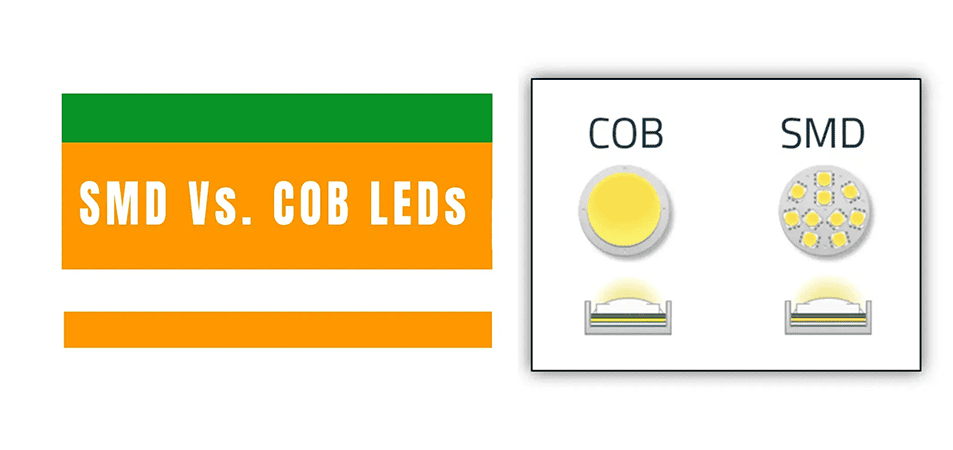
SMD stands for surface mount device. Each pixel is a single package containing one red, one green and one blue LED chip, soldered onto the driver board by high-speed reflow ovens. The classic packages carry names such as 1010, 1515, 2020, 2727 and 3535, and the numbers refer to the physical size of the package in tenths of a millimeter.
2.1 How SMD packaging works
The finished module is a dense grid of tiny black beads sitting on a dark PCB, usually finished with a matte black mask that reduces glare and increases apparent contrast. Because the beads protrude slightly above the mask, the pixel grid remains visible from close range. SMD has been the industry standard for more than two decades, so the supply chain is deep: lamp beads, driver ICs, masks and modules are available from hundreds of factories, which keeps prices low and lead times short.
2.2 Where SMD displays still win
- Larger pitches. From P2.5 outdoor billboards to P10 stadium screens, SMD is mature, proven and economical.
- Serviceability. A damaged pixel can be identified and replaced individually, a decisive advantage when a single bright failure would otherwise sit in front of an audience.
- Flexible procurement. Modules from multiple suppliers can be compared directly, and spare parts will remain available for years.
- Rental and events. Rental fleets standardize on SMD because damage is expected and repair is quick and cheap.
3. What Is COB LED Display Technology?
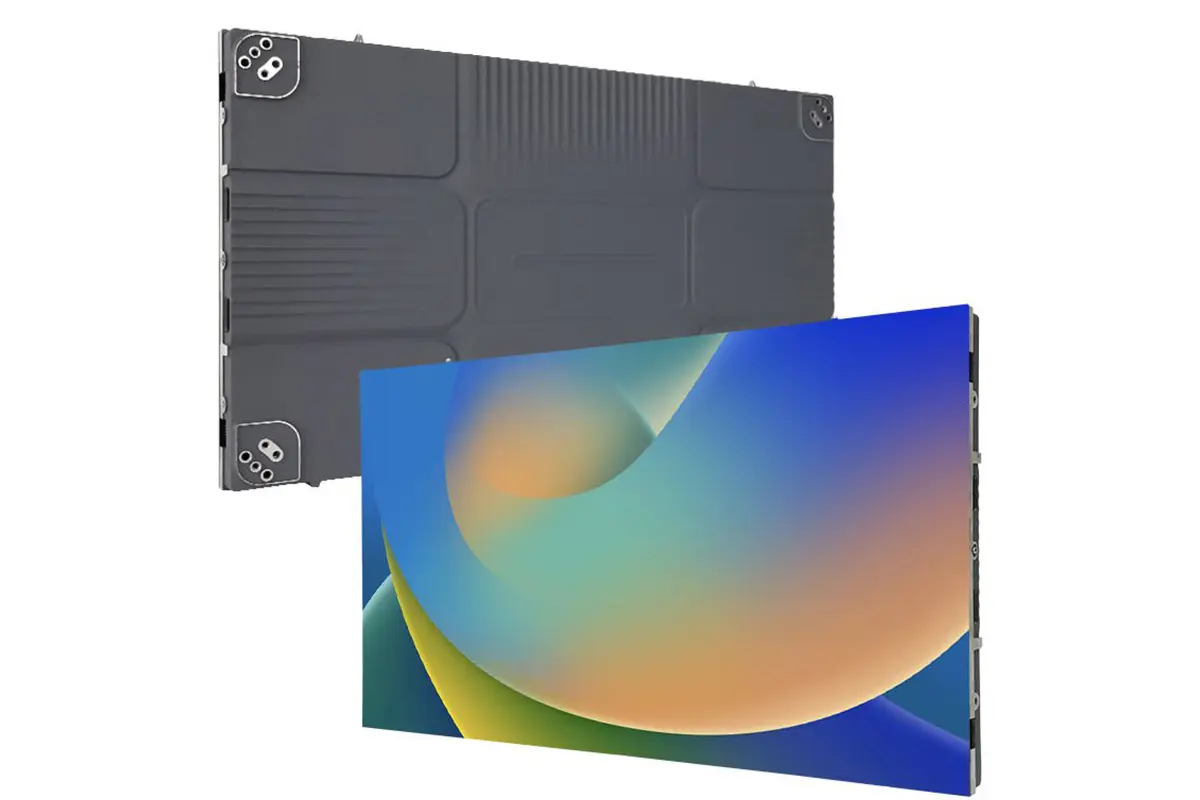
COB stands for chip on board. Instead of mounting finished lamp beads, the COB process places bare LED chips directly onto the PCB, wires them in place and then pours a layer of protective epoxy or resin over the entire module surface. There are no beads, no exposed solder joints and no gaps between pixels.
3.1 How COB packaging works
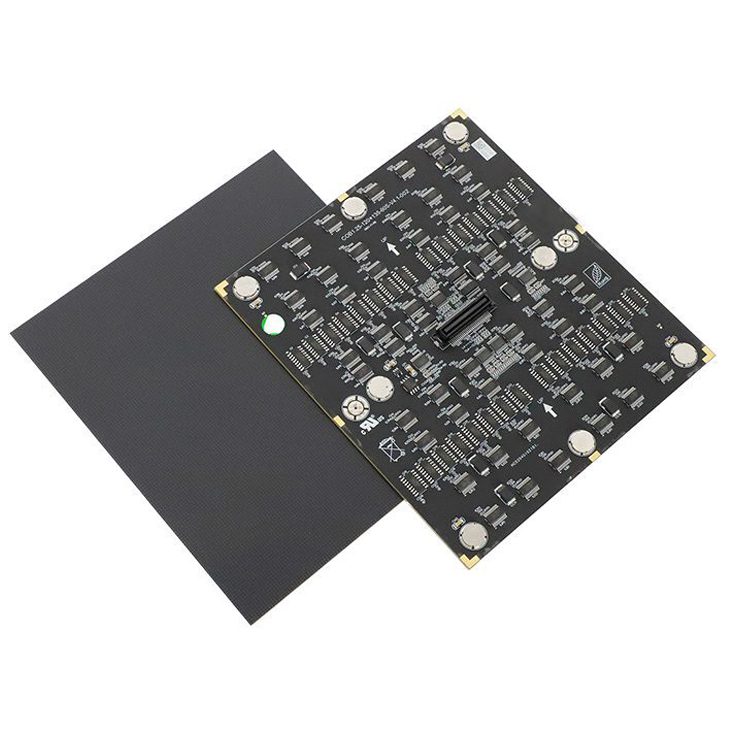
Because the chips sit in a single flat plane and the resin layer acts as a diffuser, COB modules look like a solid black board rather than a field of dots. The encapsulation protects the LEDs from moisture, dust and contact, and the direct die attachment improves heat transfer from chip to PCB. The trade-off is manufacturing complexity: yield rates at very fine pitch are lower than SMD, which is the main reason COB still costs more per square meter. You can see current module options on our COB LED display module page.
3.2 Where COB displays win
- Fine pitch. COB is available from 0.4 mm to 1.8 mm, where SMD assembly becomes fragile and expensive.
- Close viewing. Control rooms, boardrooms, broadcast studios and showrooms need smooth images at two to three meters.
- High-touch locations. Museums, retail displays, schools and airports all benefit from a surface that cannot lose a lamp bead.
- Harsh environments. Humid, coastal, dusty or wash-down areas favor a sealed, IP65-rated module.
4. Image Quality: SMD vs COB LED
Image quality is where COB has made the strongest case in recent years, but the advantage is concentrated in specific parameters. Resolution still depends on pixel pitch, and peak brightness still depends on the LED bin and drive current; packaging changes contrast, viewing angle, uniformity and how the image behaves up close.
4.1 Contrast and black level
SMD masks have improved dramatically, and a modern fine-pitch SMD panel can reach 8,000:1 or even 10,000:1. COB goes further because the resin layer is naturally ink black and matte, reflecting far less ambient light. The result is a deeper black level and, in a bright room, a punchier image that does not need to be driven at maximum brightness. For lobbies, retail windows and studios with controlled lighting, that difference is visible to any client standing in front of the wall.
4.2 Viewing angle, uniformity and close-range viewing
SMD viewing angles run from about 140 to 160 degrees, with a slow color shift toward the extremes. COB modules typically deliver 160 to 175 degrees with less color drift, because the diffusing resin layer spreads light evenly across the pixel. At close range, the SMD pixel grid produces a grainy “mosquito net” texture, while COB looks continuous. COB also tends to show better color and brightness uniformity across a large wall, since binned chips are spread under one continuous surface rather than sitting in individual packages. In a side-by-side SMD vs COB LED demonstration, these differences appear the moment viewers step closer than three meters.
4.3 Image quality comparison table
| Image parameter | SMD | COB |
|---|---|---|
| Contrast and black level | Good; limited by bead reflections | Excellent; matte ink-black surface |
| Viewing angle | 140 to 160 degrees | 160 to 175 degrees |
| Close-range appearance | Visible pixel grid and grain | Smooth, continuous surface |
| Brightness uniformity | Depends on binning quality | Naturally even across the wall |
| Camera moire | Higher risk on broadcast cameras | Reduced by the diffusing surface |
| Refresh rate | 3,840 Hz and above available | 3,840 Hz and above available |
5. Durability: SMD vs COB LED
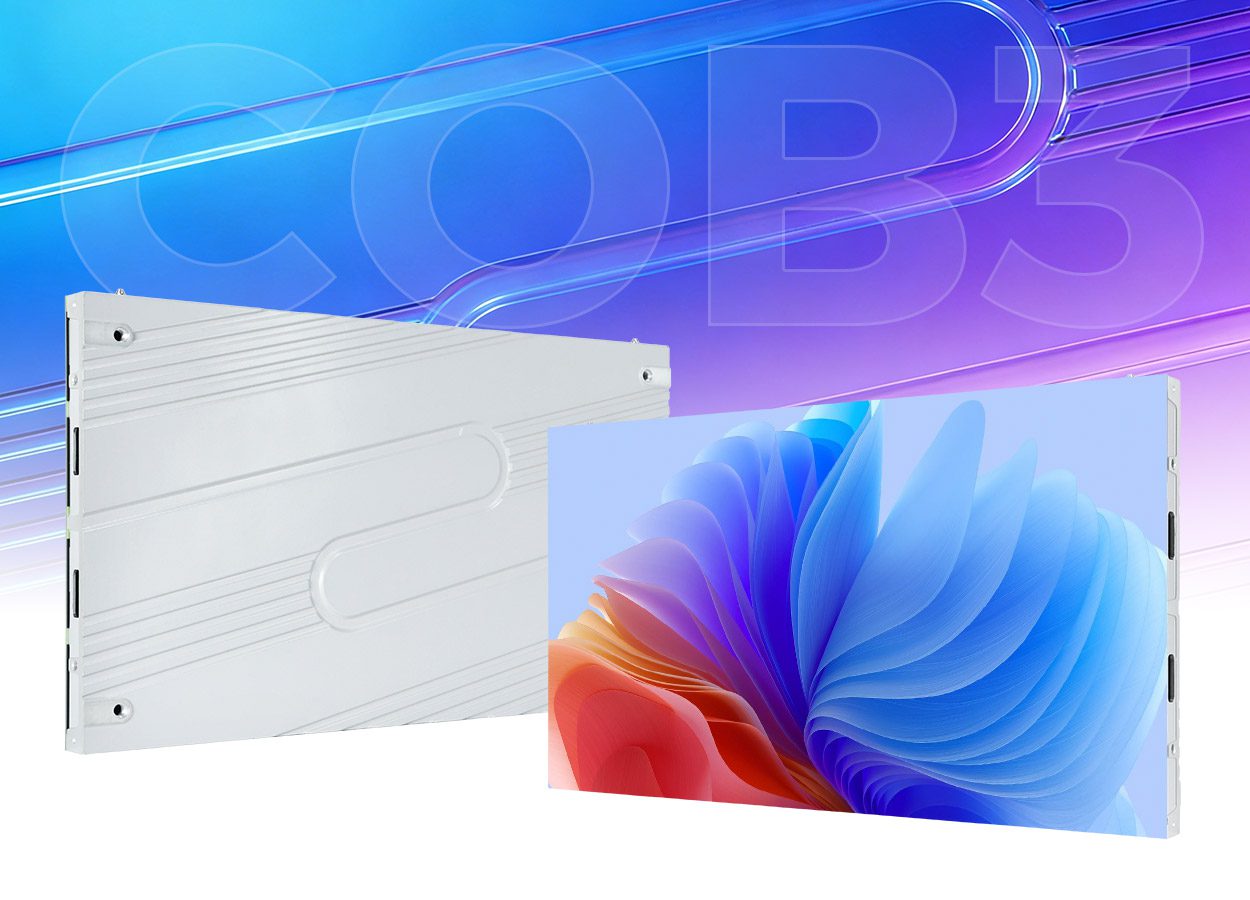
Durability is where the two packaging technologies differ most visibly to the people who own and operate the screen. A video wall is not a sealed television; it lives in lobbies, concourses, studios and public spaces where people lean on it, cleaners pass cloths over it and humidity rises and falls with the seasons.
5.1 Impact and handling resistance
An SMD lamp bead is a small ceramic package attached by solder joints, and a direct knock can shear it off, leaving a permanent black dot. Every module that travels to a trade show, every screen within arm’s reach of the public and every panel installed in a school corridor is exposed to that risk. COB modules have no beads to detach. Vendors routinely demonstrate the point by pressing a thumb or rolling a small ball across a live COB module, and installers can handle the panels without protective film. For touch-adjacent installations, that robustness alone often justifies the price difference.
5.2 Moisture, dust and static
Humidity is the quiet killer of SMD screens in tropical and coastal climates. Moisture condenses at the bead-to-board interface, corrodes the solder joints and causes dead pixels that multiply over time. Dust settles between beads and is difficult to remove without risking damage. Static discharge during handling can also damage driver ICs. The resin layer in a COB module seals the LEDs, joints and driver connections against all three threats, which is why COB can achieve IP65 protection indoors and why it is increasingly specified for outdoor fine-pitch projects as well.
5.3 Failure rates and maintenance
Statistics from accelerated life testing show COB failure rates an order of magnitude lower than SMD at fine pitch, because eliminating lamp beads and their solder joints removes the weakest link in the chain. Real-world numbers depend on the product and the site, but the maintenance logic is straightforward: an SMD wall needs a technician who can rework individual pixels, while a COB wall is serviced by swapping modules, which is faster and less skill-dependent. If downtime is expensive, module-level service and front access are worth more than the lowest purchase price. Buyers who want a middle path between the two technologies can also consider GOB LED modules, which wrap conventional SMD in a protective glue layer.
6. Cost: SMD vs COB LED
Cost has been the traditional argument for SMD, and it still wins on sticker price in most comparisons. The gap, however, has narrowed sharply. The price gap at mainstream fine pitches fell from roughly 40 to 50 percent in 2022 to about 15 to 30 percent by 2026, as COB yields improved and demand from control rooms, studios and retail grew.
6.1 Upfront purchase price
The table below shows indicative 2026 market ranges for screen and cabinets only, in US dollars per square meter. Controllers, structure, installation and taxes are excluded, and actual quotations vary with brand, cabinet, chip bin and order size.
| Pixel pitch | SMD (indicative) | COB (indicative) | COB premium |
|---|---|---|---|
| P1.25 indoor | $1,700 to $2,300 | $2,000 to $2,800 | 15 to 25 percent |
| P1.5 indoor | $1,400 to $1,900 | $1,650 to $2,300 | 15 to 25 percent |
| P1.86 indoor | $1,150 to $1,600 | $1,400 to $2,000 | 20 to 30 percent |
| P2.5 indoor | $850 to $1,250 | $1,100 to $1,650 | 25 to 35 percent |
| P4 outdoor | $700 to $1,100 | $950 to $1,500 | 30 to 40 percent |
6.2 Repair and maintenance costs
Repair economics favor COB more than the sticker price suggests. Replacing a single SMD pixel requires a skilled technician, a hot-air rework station and a site visit; the bead itself costs cents, but the labor does not, and repeated visits add up. COB service is a module swap that a local technician can perform in minutes, especially with front-access cabinets. COB spare modules cost more per unit than a bag of lamp beads, but the total cost of ownership depends on how often the screen fails and how expensive an outage is. A dead pixel in a shopping mall or a control room costs far more in reputation and lost operation than the parts themselves.
6.3 Five-year total cost of ownership
The comparison below models a 10 square meter P1.5 indoor wall, running eight hours a day for 250 days a year, at an electricity price of $0.15 per kilowatt hour.
| Cost item | SMD 10 m2 | COB 10 m2 |
|---|---|---|
| Screen and cabinets | $18,000 | $23,000 |
| Spare parts provision | $700 | $900 |
| Repair labor over 5 years | $1,200 | $400 |
| Electricity (10,000 hours) | $3,300 | $2,700 |
| Five-year total | $23,200 | $27,000 |
In this example COB still costs about $3,800 more over five years, so the technology only pays back where downtime is expensive, the environment is harsh, or the screen is close enough to viewers that image quality seals the sale. In dry, low-traffic indoor sites with a tight budget and a pitch of 2.5 mm or larger, SMD remains the rational choice.
7. Power Consumption and Heat
COB modules typically draw 10 to 25 percent less power than SMD at the same brightness, for two reasons: the resin diffuser spreads light more efficiently across the pixel, and chips bonded directly to the PCB run cooler. A P1.5 SMD wall might average 220 watts per square meter with typical video content, while a comparable COB wall averages closer to 180. Across 10 square meters and 10,000 operating hours, that gap is worth roughly $600 in electricity, as the table above shows. The bigger benefit is thermal: lower junction temperatures slow LED degradation, so a cooler screen holds its brightness and color calibration for longer, and the HVAC load in a closed control room or studio drops as well.
8. When to Choose SMD vs COB LED Displays
Use the scenarios below as a starting point, then confirm pitch with a pixel pitch calculator before you finalize the specification.
| Scenario | Recommended | Why |
|---|---|---|
| Outdoor billboard, pitch P5 or larger | SMD | Mature, bright, lowest cost per square meter |
| Control room or boardroom, P1.2 to P1.5 | COB | Smooth close-range image, low glare, high uptime |
| Rental fleet or touring event | SMD | Cheap pixel-level repair after transport damage |
| Museum, airport or school at arm’s reach | COB | Impact-resistant surface that visitors can touch |
| Broadcast studio or virtual production | COB | Uniformity, reduced moire and wide viewing angle |
| Budget indoor wall, P2.5 or larger, long viewing distance | SMD | Lowest upfront cost with no visible quality penalty |
| Coastal or tropical installation | COB | Sealed modules resist humidity and corrosion |
A third option is emerging as well: MiP (micro LED in package) combines SMD-style handling with fine-pitch performance and sits between SMD and COB on both price and protection. If your project is still at the specification stage, read our guide to MiP LED display technology alongside this comparison.
9. FAQ
9.1 Is COB LED better than SMD LED?
COB is better at fine pitch, close viewing, contrast and protection, which is why control rooms, studios and high-touch installations have moved to it. SMD remains better value at pitches of 2.5 mm and above, and better for rental fleets where pixel-level repair matters. The honest answer is that each technology wins in a different part of the market.
9.2 Is COB LED worth the higher price?
For a fine-pitch wall in a humid or high-traffic environment, the durability and service savings usually justify the 15 to 30 percent premium. For a large-pitch indoor screen with a long viewing distance and a tight budget, the premium buys little that viewers can see.
9.3 Can a COB LED display be repaired?
Yes, but the method differs. A damaged COB module is normally replaced as a whole unit, which is fast and can often be done from the front. Some manufacturers now offer surface-repair processes for individual chips, but module replacement remains the standard procedure.
9.4 Which lasts longer, SMD or COB?
Both technologies carry rated lifetimes of around 100,000 hours, but COB reaches that figure with fewer failures along the way. Sealed modules avoid the corrosion and impact damage that shorten SMD life in real installations, and their lower operating temperature slows brightness decay.
9.5 Does SMD vs COB LED affect power consumption?
Yes. COB modules typically consume 10 to 25 percent less power at the same brightness, and they run cooler. Over a five-year ownership period the energy difference is real, though it rarely outweighs the difference in purchase price on its own.
10. Conclusion
SMD vs COB LED is no longer a one-sided contest. COB now owns the fine-pitch segment thanks to superior contrast, wider viewing angles, sealed protection and lower maintenance, while SMD still delivers unbeatable value at larger pitches with easy pixel-level repair. Match the technology to viewing distance, environment and downtime cost rather than to price alone, and request like-for-like quotations on both options before you commit. For most projects above P2.5, SMD wins on budget; below P1.5, or anywhere the screen is touched, damp or mission-critical, COB is the safer investment.

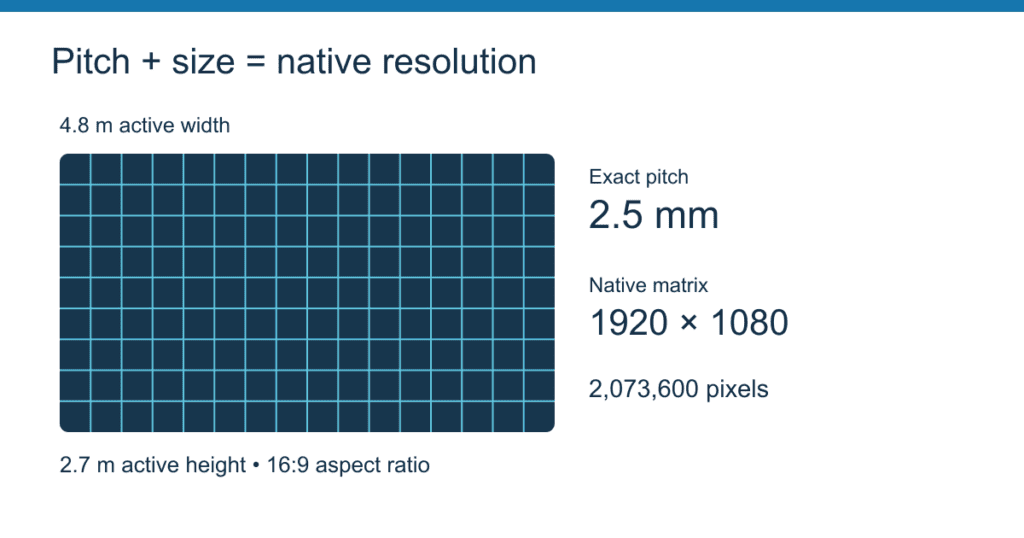 LED Display Resolution Calculator: Pitch, Size and Pixels